


Your sponsorship here.
Policy Hawk Studies is piloting a sponsorship offer for organizations wishing to build and maintain visibility within the Canadian defence and security community.
For details, or to see how Policy Hawk Studies will maintain its editorial independence, click here.
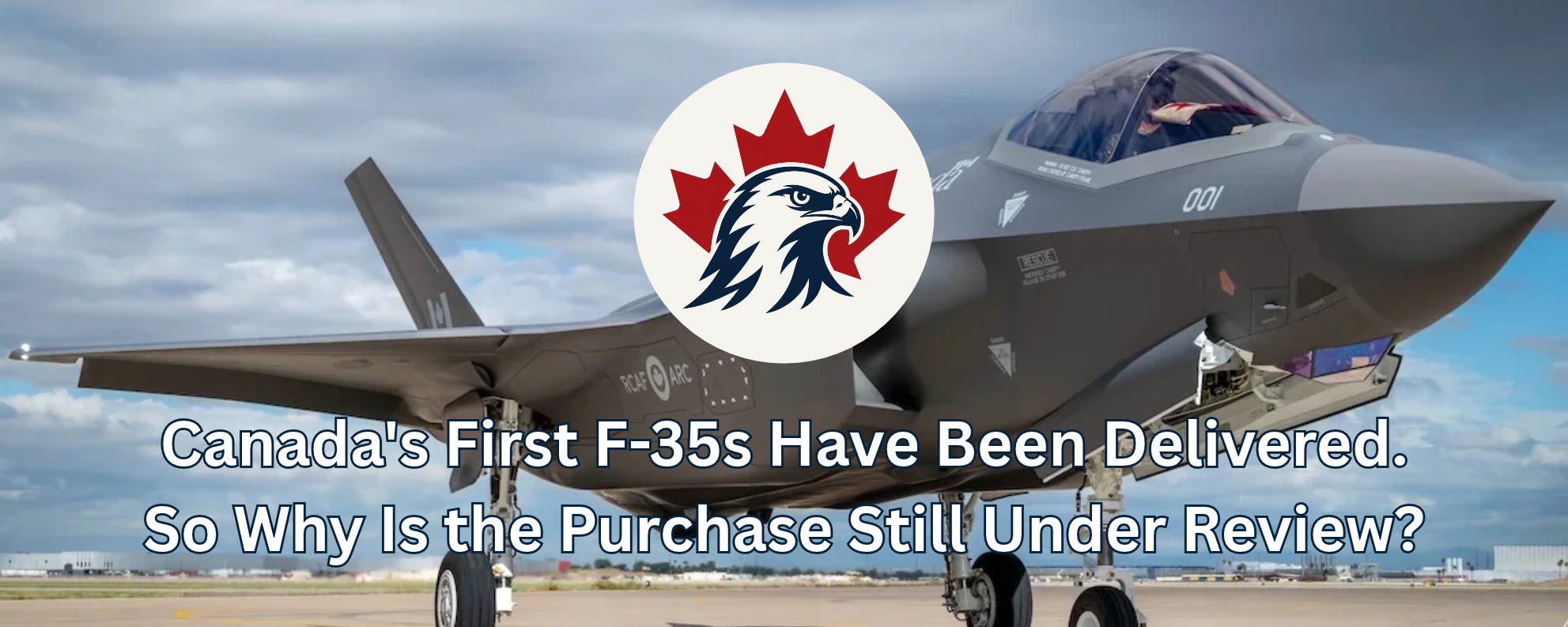
On Thursday, the Royal Canadian Air Force took delivery of its first two F-35 fighter aircraft. After years of announcements, reversals, reviews, and arguments about whether Canada would or should actually buy the F-35, aircraft are finally being delivered… in a sorta, kinda, “it’s complicated” way that feels entirely consistent with this program’s history.
The two aircraft delivered this week are the first of the 88 F-35As (officially designated the CF35A in Canadian service) Canada agreed to purchase in 2023. While this delivery to the RCAF is an important milestone, delivery to the RCAF does not mean they have arrived in Canada. These particular aircraft, along with the next six, will remain in the US at Luke Air Force Base, where Canadian pilots will train as the RCAF brings this new fighter into service. Some aircraft may visit Canada earlier, but deliveries to Canadian bases are not scheduled to begin until 2028.
This delivery may confuse Canadians who have spent the last year and a half hearing politicians and the media discuss how this program is under review, and question whether Canada should acquire a different fighter — most commonly, the Saab JAS 39 Gripen. It would be easy to assume this delivery signals that review is over with the F-35 winning out, however, that is not the case.
Launching a review of the F-35 acquisition was one of Mark Carney’s first decisions after becoming Prime Minister in March 2025. In the months that followed, it was signalled numerous times that the review would be concluded relatively quickly — with Minister of National Defence McGuinty at one point putting a seemingly firm deadline at the end of summer in 2025. That date came and went with no conclusion. The official line since then has been that the Government will take as long as it needs to complete the review and will not be rushed.
The reason for the bait-and-switch on the conclusion of the review has never been explicitly stated, however, it is commonly speculated that it is substantively complete and the government is primarily delaying the decision to use it as leverage in trade negotiations with the US. Without directly confirming that rationale, McGuinty has acknowledged that the purchase figures in discussions with Washington.
That leaves the question of why F-35s are being delivered, even as that review is on-going. Answering this requires some knowledge of the purchase agreement’s structure. Although not all details are publicly known, it is evident that Canada’s 88 aircraft order is split into a number of “tranches” or groups of aircraft. Each tranche is independent from the others, and Canada only becomes contractually obligated to each one when it passes a specific decision point shortly before production on that tranche begins. Until then, Canada can reduce or cancel the aircraft in that tranche with, seemingly, little or no penalty.
By the time Carney took office, Canada was already committed to buying the first 16 F-35s. It has since made initial payments toward another 14, though officials have remained coy about whether those payments commit Canada to purchasing those aircraft. Either way, the contract’s structure means that the acquisitions within committed tranches can go ahead at their planned speed, even while the review is considering what to do with future tranches.
There is, of course, a deadline to this approach. It is not publicly known when the decision points for future tranches will arrive, but they will arrive. Nonetheless, this explains how Canada can be receiving F-35s while still reviewing the program as a whole.
If receiving F-35s while reviewing the purchase still seems like a strange contradiction, that is a feeling that has been common throughout the program’s history. Canada’s involvement in the F-35 program has repeatedly involved positions that seem contradictory — at least, until you untangle the decisions involved.
This has been true as far back as 1997, when Canada first became a partner in what the US was calling the Joint Strike Fighter program. This was actually before Lockheed Martin was selected as the manufacturer of the jet. One normally thinks of early partners in the development of military equipment as being reasonably committed to purchasing that equipment — at least if everything pans out — however, there was no such commitment in this case. Rather, in exchange for an on-going financial commitment that has, to date, added up to approximately $1 billion in direct payments, Canada was granted access to certain technical information related to the program and the opportunity for its industry to bid on the program’s sub-contracts. No guaranteed work, just the chance to bid on contracts. Economists can judge whether the $1 billion in direct payments was worth investing for the approximately $5.2 billion in F-35 contracts Canadian companies have received since. However, it is an unusual dynamic to say the least.
After joining, the program largely ticked along in the background without drawing much attention in Canada for a number of years. That changed in 2010, when the government of Stephen Harper announced a decision to purchase 65 F-35As for the RCAF through a sole source process that skipped competitive bidding and other steps usually part of Canadian Defence procurements. It justified this approach, in part, by arguing that participation in the multinational program would reduce both the purchase price and the cost of supporting the aircraft.
However, when the Commons’ finance committee requested the estimated cost of each F-35 and how the purchase fit into the government’s financial plans, in late 2010, the information was not provided. The committee, and then the House as a whole, would issue follow-up orders to provide documents covering acquisition costs, lifetime costs, and operational requirements for both the F-35 and the existing CF-18. Some documents were eventually provided, but MPs claimed they were incomplete.
The issue developed into a more general one about whether the government could refuse information Parliament required to examine its decisions. Other topics were involved, but the one that stuck in the public’s mind seemed to be the F-35. In March of 2011, the House adopted a motion finding the government in contempt of Parliament for not sharing what had been ordered and withdrawing confidence — forcing an election.
Stephen Harper’s Conservatives would emerge from that election in a stronger position, winning their first majority government. But, in the way of elections, the distinctions between opposing the aircraft, opposing a sole-source purchase, and questioning the government’s cost figures became simplified. The political argument increasingly became one between “pro-F-35” Conservatives and “anti-F-35” opposition parties.
Despite the pro-F-35 Conservatives’ new majority, the acquisition was still to experience turbulence. In April of 2012, an Auditor General’s report indicated that National Defence had publicly stated the acquisition would cost $14.7 billion, while internally using a $25 billion figure, and that parliamentarians had inaccurately been told that cost data had been validated, while expected cost increases were omitted. The difference in cost figures was largely (but not entirely) related to the inclusion of operating and personnel costs in the internal estimate, while they were excluded in the public figure. But the Auditor General’s findings made it much harder to dismiss the controversy as opposition parties simply disliking the F-35. There were substantive problems with the information Parliament had received and the government chose to freeze acquisition funding and announce a plan to contract an independent review to examine the purchase and improve cost reporting.
In December, another blow came when the contracted independent review was released by KPMG with a headline cost figure of over $45 billion. This estimate was for the project’s full life, which none of the earlier figures claimed to address, however, it further undermined the government’s assurances about what Canada would be spending.
As reports of the findings emerged, news outlets began describing the planned purchase as cancelled, with some reporting that a new competition was expected. The government disputed the cancellation reports, but on December 12 it announced a “reset” in which it would set aside the requirements that had led it to the F-35 and reassess the available aircraft. The F-35 remained an option, but the government no longer claimed it was a foregone conclusion… except when it did.
Throughout all of this, in another one of the program’s contradictions, the Government of Canada had never actually signed a contract to purchase the F-35. This allowed the government to retreat from its announced purchase without the need to unwind any binding agreement with the US government or Lockheed Martin, but it is strange that a government that had spent so much political capital defending this purchase never actually signed a contract to complete it. Over the remaining years of the Harper government, officials continued evaluating alternatives and updating cost estimates but, despite some statements from Conservative MPs discussing the F-35 as if its selection was still active, neither it nor any other replacement fighter was ordered nor was any timetable for such an order ever firmly established.
By the time the 2015 election arrived, the Conservatives were still defending its handling of the project and not visibly pushing the replacement of the CF-18 forward. Meanwhile, the opposition including, especially, the Liberal party took a more definitive stand. Their election platform that year first stated, “We will not buy the F-35 stealth fighter-bomber” while the very next sentence promised an “open and transparent competition” to replace the CF-18s. These commitments were likely written while the Liberals were a distant third place in polling, and it is unclear how they reconciled, or if they even acknowledged internally, the contradiction between a promise not to buy one particular fighter, alongside a promise of an open competition. However, they won the election, and needed to find a path forward.
The path they chose added another purchase to the equation. Canada has commitments to both NORAD and NATO to maintain a certain number of aircraft available at any given time based on alert levels. However, these were not treated as cumulative, a four aircraft (as an example) availability commitment to NORAD and a four aircraft availability commitment to NATO required only four, not eight, aircraft. When alert levels for both were high, the RCAF could not meet both requirements with separate aircraft even if it wanted to with the size of its fleet. This was accepted by government policy, until the Liberal government spotted it and changed it to require the RCAF to be able to meet both commitments simultaneously. This policy change created a fighter capability gap, which in turn gave the government a pretext for acquiring what it called an “interim” fleet through a non-competitive process to address the shortfall without waiting for the full CF-18 replacement to be complete.
Based on this new fighter gap, in November 2016, the government announced that it intended to sole-source the purchase of 18 Boeing Super Hornets to serve as this interim fleet while preparing the larger competition. The impact, and likely intention, was to give the Super Hornet a head start in the eventual competition. Acquiring an interim fleet would mean investing in infrastructure, training, and support systems for one of the F-35’s competitors, strengthening the case for buying more Super Hornets as the permanent replacement. If this resulted in the Super Hornet winning, it would reconcile the Liberals’ campaign promises, allowing them to hold an open competition without the awkward outcome of the F-35 winning.
Then Boeing made itself a much harder company for the Canadian government to buy from. In April 2017, five months after the Super Hornet announcement while negotiations were still on-going, Boeing filed a trade complaint against Canadian manufacturer Bombardier’s C Series passenger jet — which it saw as competition for its 737 — alleging that subsidies and below-market pricing had allowed the Canadian manufacturer to unfairly secure a sale to a US airline. By the fall, preliminary US Commerce Department decisions had put the aircraft under the threat of combined duties approaching 300%, jeopardizing its access to the American market.
Whatever Boeing thought of the merits of its complaint, the political implications in Canada were fairly obvious. The company was asking Ottawa to award it a substantial military purchase without competition while asking Washington to impose punishing duties on a major Canadian aerospace project. A Super Hornet purchase that had offered the Liberals a politically convenient way around the F-35 problem had become a political liability of its own.
In December 2017, Canada abandoned the proposed Super Hornet purchase and instead announced that it would acquire second-hand Australian F/A-18s to supplement its existing fleet. It also launched the competition for the permanent replacement, warning that bidders responsible for harming Canada’s economic interests would be at a disadvantage. Boeing was not excluded, but the message was difficult to miss.
The tariff case itself would fall apart the following month — though not before Bombardier was forced to strike a deal with Airbus that would eventually see it lose ownership of the C Series design — when the US International Trade Commission found that the Canadian aircraft had neither materially injured nor threatened material injury to the American industry, preventing the duties from taking effect under final orders. But by then Canada had already changed course. Boeing’s attempt to protect its commercial aircraft business had cost it the interim fighter sale and its advantage in the larger follow-on competition.
When that competition started, it initially attracted five aircraft, the F-35, Super Hornet, Saab Gripen, Eurofighter Typhoon, and Dassault Rafale. But the field soon narrowed. Dassault withdrew in 2018, amid reported concerns about Canada’s interoperability and intelligence-sharing requirements. The Airbus-led Typhoon team followed in 2019, explicitly arguing that the security requirements associated with NORAD imposed excessive costs on aircraft whose manufacturing and repair networks sat outside the Canada-US security relationship.
These objections illustrated a difficulty inherent in the competition. Canada could invite aircraft from several countries to compete, but whichever it chose would need to function within its unusually close defence relationship with the United States. Requirements arising from that relationship could be operationally justified while still making the competition substantially harder for non-US aircraft. Saab, based in Sweden, nevertheless remained in the running, alongside the two US contenders.
While it was clear that the competition was running from 2018 onwards, there were few indications (although much speculation) about its internal machinations as it took place. That changed in late 2021 when the Super Hornet was eliminated for failing to meet one of the project’s mandatory requirements. Meanwhile, the Gripen and the F-35 received a tacit stamp of approval as being eligible to proceed.
The detailed reason for the Super Hornet’s elimination has not been publicly explained. However, I have heard from a source I believe would know, but whom I cannot name, an explanation involving the competition’s communications and cryptographic requirements. According to that account, Canada requested detailed information to establish that the proposed aircraft could meet the secure communications requirements associated with NORAD operations which required certain functions to take place within Canada or the US. This was a potentially difficult hurdle for the Gripen, given its origins outside the US system, and a cynic could easily wonder if it was intended to knock the Gripen out of the competition entirely, but Saab supplied what Canada required through creative partnership agreements with Canadian companies.
Both American aircraft would presumably have been capable of meeting the underlying operational requirement, however, the nature of the competition as a fair one meant that if Saab had to prove it could meet the requirements, so did the other aircraft. However, the level of detail that was requested was apparently so invasive that US authorities balked at sharing it with Canada when Canada may not proceed with the purchase. According to the same source, the F-35 team worked around this by obtaining a letter from the relevant US authority (plausibly the NSA) confirming compliance without sharing specifics, while the Super Hornet team responded that it could not provide the information. The Super Hornet was then eliminated for failure to meet mandatory requirements.
This entire account is single-source, and should be treated as unconfirmed and potentially missing context. But, if at all accurate, it is a fascinating way for the once presumptive favourite to be eliminated from the competition.
Whatever the precise reason for Boeing’s elimination, the competition had produced an outcome quite different from the one the interim Super Hornet proposal might have encouraged. The aircraft the Liberals had once sought to acquire without competition was out. The aircraft they had promised not to buy remained eligible, alongside the Gripen.
It wouldn’t take long for a decision to be reached between these two aircraft, with the government announcing in March of 2022 that the F-35 was the top-ranked bidder and that it would proceed to final negotiations. Why the F-35 was selected over the Gripen has never been officially stated. Although, the F-35 is clearly the more capable aircraft in the air. One part of the evaluation of the aircraft that was leaked in 2025, in a transparent bid to influence the on-going review decision, indicated that the F-35 scored 57.1 out of a possible 60 points in its capability evaluation, while the Gripen only scored a 19.8. The leaked figures came with very little context and appeared to cover only non-mandatory requirements — both aircraft were deemed able to do what was mandatory — and other aspects of the evaluation were never released. But it is obvious this would have been part of the consideration.
Regardless of the reasons why, in January 2023, Canada confirmed an agreement to acquire 88 F-35s from Lockheed Martin. This was not the end of the story but it, effectively, brings the story of the F-35 full circle with the next major development being the launch of the review in 2025 and then the delivery of the first two this week.
Where the story goes from here remains unclear. The deterioration in Canada’s relationship with the United States introduces real concerns that did not exist when the F-35 won the competition in 2022. That has been fuel for the on-going review. But, as has been discussed in earlier Policy Hawk Studies pieces, choosing another aircraft does not automatically remove US dependencies — certainly not all of them in the near future — and introducing a second fighter would place additional demands on the people needed to keep the CF-18s flying while bringing their replacements into service. There are compromises whichever direction Canada chooses.
For all the reversals in this history, this delivery does change something. In 2012, the government could step back from its announced purchase without cancelling an order for aircraft. Today, Canada is receiving aircraft it has committed to buying, while reviewing how far to proceed beyond those commitments. The review can still change the composition of Canada’s future fighter fleet, but Canada as an operator of at least some number of F-35s is no longer a hypothetical.
That makes the outcome of this review more consequential, rather than less. Buying fewer F-35s would require a plan for completing the fighter force with something else, including how the RCAF would manage another transition. Proceeding with all 88 would require the government to explain why the concerns that prompted the review can be managed. Either decision will attract criticism. After this history, that much is certain.
Thanks for reading! What do you think Canada should do about its fighter fleet? Let me know in the comments.
If you found this useful, please like it or share it with someone who might be interested. That helps this work reach more readers.
You can also subscribe for free or become a paid supporter. Everything I publish will remain free; subscriptions and one-time tips simply help me write more often.
Thanks!
I will add a bit to the technical evaluation. Most people don't understand how that technical score was derived.
One of the challenges faced by the evaluation team was constructing an evaluation with different aircraft and capabilities and weapons.
The solution was a scenario based evaluation. The bidders were each given the same set of scenarios/missions to simulate. They had to detail various outputs. But notably how many aircraft to achieve the mission and what ancillaries (targeting pods for example) and weapons were used. Everything they used in their scenario has to be included in their bid.
Turns out a low observable fighter with a lot of sensors and computing power needs fewer aircraft, no ancillaries and fewer weapons to get the job done. This has knock on effects for costs, personnel requirements, etc. across the lifecycle.
Something a lot of Wikipedia warriors don't get is that a targeting pod costing several million, is not a throwaway consideration. It requires an entire supply chain with regular maintenance. And an air force and military short on personnel is going to be substantially more sensitive to total personnel requirements than other costs.
I had a thought that may give the RCAF a solution to the dilemma of what to do with an over priced hanger queen F-35s. The RCAF has never had a dedicated ‘Aggressor Squadron’ for training purposes.
Since purchasing the full wishlist 88 aircraft will render the RCAF’s readiness to its lowest level ever. The balance of the estimated costs for the F-35s would pay for several squadrons of the Gripen as well as missiles and transport aircraft to replace the Hercules.
I still recall an interview with one of the engineers involved in designing the F14, and when he was asked for his opinion of the F35, he called it a ‘turkey’. It is not a practical choice for an air force that will not be operating from well cleaned concrete runways and have access to high tech maintenance needed to keep an F35 going in the Arctic, or Poland or elsewhere in the world.
I hope that the mandrins of NDHQ will get their heads out into daylight long enough to see what is needed by the pilots who will have to go into combat.
I have a feeling it may be a forced situation, since we have already been offered domestic production with Saab, and in the face of a protracted trade war with the US, we will need that as much as we need the aircraft.