


Your sponsorship here.
Policy Hawk Studies is piloting a sponsorship offer for organizations wishing to build and maintain visibility within the Canadian defence and security community.
For details, or to see how Policy Hawk Studies will maintain its editorial independence, click here.
Should Canada Risk Training Chinese Troops?
By: Jon
On Tuesday, Blacklock’s Reporter published a story alleging that then-defence minister Anita Anand approved Canadian Armed Forces personnel training members of China’s People’s Liberation Army in 2023. The report also claimed there was an attempt to “conceal the fact” of this training. Coming shortly after reports last week that Canada and China had held their first Defence Coordination Dialogue since 2018, the story rapidly became a focus for critics of the government, especially on social media.
At first glance, this criticism seems well founded. China has interfered in Canadian politics, arbitrarily detained Canadian citizens, materially assisted Russia in its unprovoked and illegal war against Ukraine, and repeatedly threatened Taiwan and other Canadian partners in the Indo-Pacific. Despite a limited rapprochement in recent months, China remains one of the states Canada might plausibly face in a major-power war, almost certainly alongside its traditional allies. If Canadian soldiers were sent to help the PLA become more capable, Canadians would be right to ask why.
A significant amount of misleading information about this deployment has already circulated, including from sources that Canadians should be able to rely on for accuracy. For instance, Conservative defence critic James Bezan claimed that “three Canadian Armed Forces specialists were sent to China in 2023 to train members of the Chinese People’s Liberation Army.” However, that is not what appears to have happened.
The three Canadian personnel were not sent to China for a bilateral training mission. They went to Mongolia to participate in Exercise Khaan Quest 2023. Khaan Quest is an annual multinational exercise focused on United Nations peacekeeping and stability operations. It was hosted by the Mongolian Armed Forces.
Mongolia is an important global partner of NATO and has had a formal and increasingly close relationship with the alliance for over two decades. Exercise Khaan Quest 2023 was also co-organized by the United States through U.S. Indo-Pacific Command. It was at the invitation of Mongolia and the United States that Canada participated.
It is true that China participated as well. Mongolia maintains a “multi-pillar” foreign policy through which it engages with multiple global powers. That policy is consistent with inviting China to military exercises attended by other powers, and the fact that these exercises were linked to UN peacekeeping—something to which China contributes—makes the invitation even less objectionable. No official source appears to identify how many PLA personnel attended Khaan Quest 2023. In other years, however, China reportedly sent several dozen, and it is likely that its contingent in 2023 was similar.
China therefore appears to have been a bit player among the 26 countries that participated in the exercise. Contemporary reporting placed total participation at more than 1,100 personnel, including approximately 200 from the United States. Australia, France, Germany, Japan, South Korea, Sweden, Turkey, the United Kingdom, and several other Canadian partners also participated. No one should be confused by the modest Chinese presence—this was a Western-led multinational exercise, not a Chinese one.
Canada’s contribution was particularly small. According to descriptions of the disclosed records, one CAF member participated in a command-post exercise involving simulated forces and communications between headquarters. Two specialists in countering improvised explosive devices provided training and mentoring during the field exercise. Publicly released U.S. military imagery confirms that Canadian and American personnel instructed Indian soldiers in counter-IED techniques, although the available public record does not establish which other contingents received Canadian instruction.
It seems plausible that PLA personnel could have been among those receiving Canadian instruction, although this is difficult to prove. Blacklocks seems to suggest that the work history of a briefing document it obtained, which contained and then deleted the statement “there is no confirmation that CAF personnel will be directly training PLA personnel”, alongside a nearby margin-comment that “That is not true. We know we will be training and we have Minister of National Defence approval to do so”, proves CAF personnel trained PLA personnel and is the basis for their claim that there was an attempt to conceal this training.
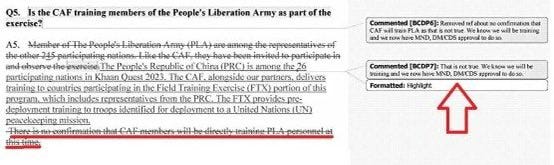
However, a careful review of the screenshot shows that the “That is not true” comment is actually linked to an earlier statement describing the CAF personnel as observers. The correction was that they would not be observers, but would instead be offering training. There is no indication why the separate statement concerning direct training of PLA personnel was deleted. Regardless, this appears to be evidence of an editorial process designed to get the facts correct, not an attempt to conceal them.
With the accusation of concealment addressed and confusion about the nature of the exercise clarified, we can turn to the question underlying the criticism. Should Canada participate in military exercises that involve China, or eschew them as a matter of principle—or self-interested common sense?
One possible answer is that Canada should refuse to participate in any military exercise that includes China. Even relatively benign contact can provide the PLA with useful techniques, insight into Canadian practices, and opportunities to build relationships or collect information. Participation also allows China to present itself as a responsible international security partner while its military threatens Taiwan, presses territorial claims against its neighbours, and prepares for the possibility of conflict with the United States.
These concerns should not be dismissed as unlikely, and the fact that an exercise is described as multinational or focused on peacekeeping does not make them disappear. Counter-IED training intended for one circumstance is still valuable in another. Participation in a command-post exercise may expose procedures and communications practices. China will attempt to learn whatever may be useful to it. Canadian personnel should not assume that a lesson is harmless merely because it is being delivered in Mongolia rather than China.
However, Canada was hardly alone in deciding to participate in Khaan Quest 2023 despite these concerns. The United States co-sponsored the event, and many of Canada’s traditional allies participated. Their presence does not prove that Canadian participation was wise—perhaps Canada should lead a broader Western policy of refusing to attend exercises involving China—but it is worth considering why so many countries facing the same basic risks as Canada did not consider the PLA’s presence disqualifying.
Mongolia is a democracy located between Russia and China. Its efforts to build relationships beyond those two powerful neighbours give it more room to act independently, but geography ensures that neither can simply be ignored. Chinese participation in some multinational activities is therefore sometimes part of the cost of engaging with Mongolia.
That engagement offers real, if modest, benefits. Mongolia has cooperated with NATO since 2005, contributed personnel to NATO-led operations in Kosovo and Afghanistan, and become a substantial contributor to UN peacekeeping. Disengagement risks losing these contributions and potentially leaving Mongolia with little choice but to turn to Russia and China as its only available military partners.
Had Canada stayed away, the exercise would still have happened. China would still have participated. The PLA might have lost access to two Canadian counter-IED specialists and one Canadian participant in the command-post exercise, but Canada would also have removed itself from an exercise hosted by a democratic partner, co-sponsored by its largest ally, and attended by many other friendly militaries.
Had all Western militaries stayed away, or threatened to stay away unless China was excluded, a country’s friendly relationship with the West could easily have turned sour. That may occasionally be the right trade. It is difficult to see why it would have been in this case.
If there is a quintessential example of an exercise Canada should continue attending despite Chinese participation, Khaan Quest is probably close to it. It took place in Mongolia, a country that is friendly with the West but not inherently aligned with it. The exercise was co-sponsored by the United States, focused on peacekeeping, included a broad group of international partners, and involved only three Canadians providing limited expertise. Even if some PLA personnel received Canadian instruction, there is no obvious reason to think the benefit to China approached the strategic cost of abandoning the exercise.
This principle applies more broadly. Refusing to attend any exercise that includes China would give Beijing an inexpensive way to narrow Canadian and broader Western engagement across the Indo-Pacific. Many countries in the region do not want to choose exclusively between China and the West. They will continue inviting both to some international activities, especially those connected to peacekeeping, disaster response, and other shared interests. If China’s acceptance of an invitation automatically causes Canada and its traditional allies to decline their own invitations, Beijing can push us out just by showing up.
We cannot compete for relationships only in rooms China has chosen to leave empty.
There are certainly exercises involving the PLA that Canada should not attend. Participation in activities designed around Chinese requirements should face an exceptionally high bar. Canada should also refuse to provide instruction involving sensitive tactics, intelligence, command systems, or advanced technology. Even in lower-risk exercises, Canadian personnel need clear limits on what they may teach, demonstrate, discuss, and allow others to observe. However, there is no allegation that Canada failed to observe those limits in this case.
In other cases, Canada should ask what the PLA could realistically gain from Canadian participation, what Canada and the host gain in return, and what Canadian absence would actually accomplish.
It seems unlikely that limited exposure to Canadian counter-IED instruction during a peacekeeping exercise would materially improve the PLA’s ability to fight a future war against us. Allowing China to cheaply box Canada out of military relationships with otherwise receptive Indo-Pacific countries might impose a far more significant cost for us.
Canada should not help the PLA become better at fighting Canada or its allies. But nor should it allow the PLA’s presence to determine where Canada can build relationships, support partners, or defend its interests. Engaging in places where there is a Chinese presence is not a concession to Beijing. It is part of competing with it.
Thanks for reading. Do you think Canada should participate in military exercises that include China? Let me know in the comments.
If you found this useful, please like it or share it with someone who might be interested. That helps this work reach more readers.
You can also subscribe for free or become a paid supporter. Everything I publish will remain free; subscriptions and one-time tips simply help me write more often.
Thanks!