


Earlier this week, many Canadians broke a long-standing national custom and did the unthinkable: they listened to a speech by a Canadian Prime Minister delivered to an international audience. Much has already been written about Mark Carney’s tour-de-force performance at the World Economic Forum in Davos, where he used Václav Havel’s famous allegory of the sign in a greengrocer’s window as an eloquent and powerful framing device for an appeal to accept hard truths.
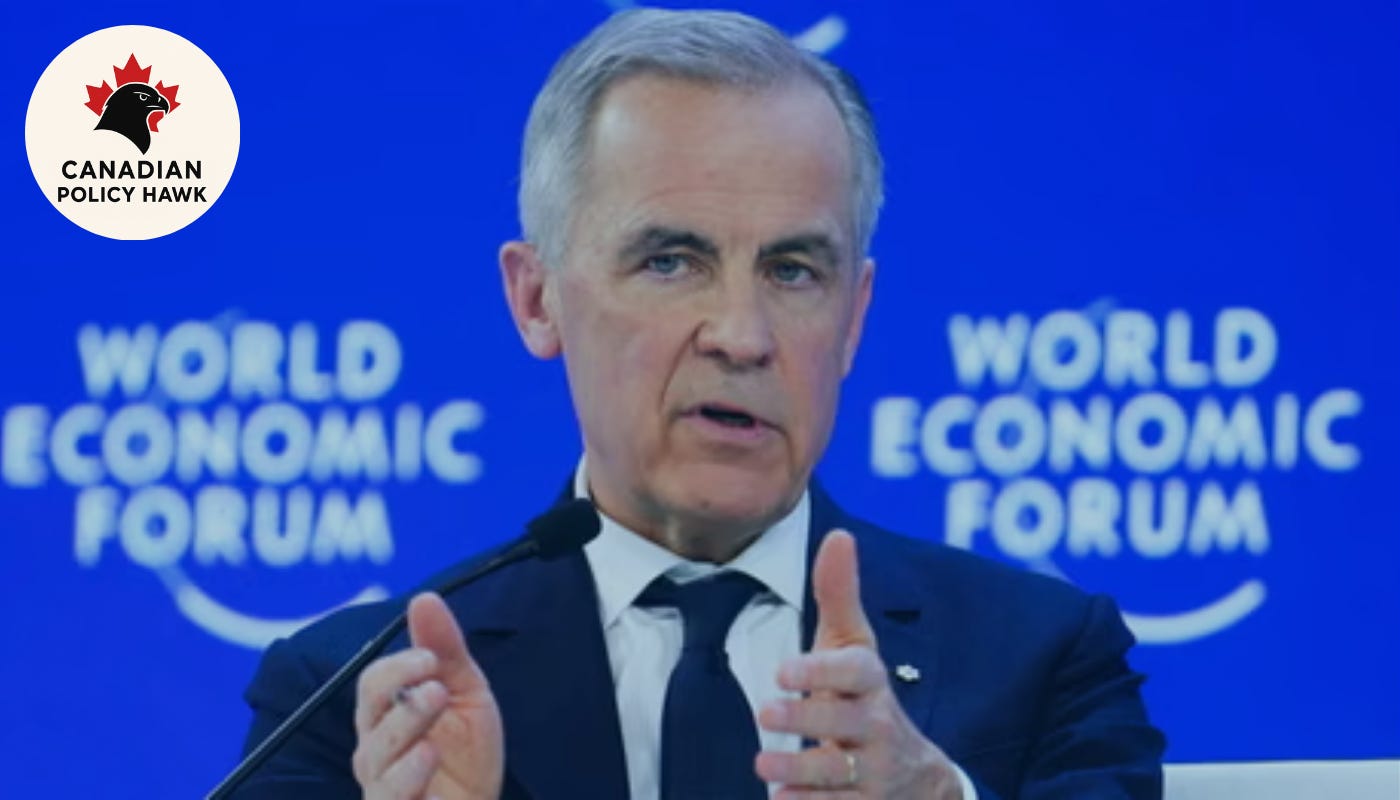
However, those who rushed to laud, or criticize, his prepared remarks may have missed a significant but subtler moment which followed. During a question-and-answer discussion immediately after the speech, with Financial Times commentator Gideon Rachman, Carney responded to a pointed question about the future of NATO by saying:
“Clearly NATO is experiencing a test, right now, and the first response to that test has to be to respond in a way that ensures the security of the Arctic in a robust way for all possibilities. This is actually a point that we have been making in recent years. [...] In the immediate term, one of the imperatives is to reinforce things that Canada is doing [and] other NATO partners [are doing] in a comprehensive way that provides much greater security in the Arctic.”
That Carney should choose to answer a more generic question on the topic of security by discussing the Arctic would not be surprising. The Arctic has nearly become the sine qua non of Canadian defence considerations under his government, as seen in last year’s Defence Policy Update, unsubtly titled Our North, Strong and Free, which goes out of its way to make clear, before a reader can even reach page 1, that:
“The most urgent and important task we face is asserting Canada’s sovereignty in the Arctic and northern regions, where the changing physical and geopolitical landscapes have created new threats and vulnerabilities to Canada and Canadians.”
No, the emphasis on Arctic security is not a surprise. What is significant is that the Canadian Prime Minister - any Canadian Prime Minister - would frame Arctic Security as a NATO priority. He did not have to do that. It’s not clear that Rachman’s question was alluding exclusively to Greenland, but it was doing so in part. So Carney could easily have limited his commentary to Greenland. Instead, he chose to speak about a more expansive role for NATO which applies across the entire Arctic.
This is noteworthy because, as Dr. Elizabeth Buchanan - an academic with a focus on Polar Geopolitics & Strategic Studies - pointed out on X:
“Canada has always been the member state to block the idea of increased NATO footprint in the Arctic - despite calls from the 3 other member state Arctic rim (A5) nations (United States, Norway, Denmark) to move beyond High North framing and establish an Arctic strategy for the alliance.”

Buchanan did not go on to explain why Canada has been obstructionist in this way. But the crux of it is not complicated.
Canada has long claimed that the waters within the bounds of its Arctic Archipelago - which include a mandatory stretch of the Northwest Passage - are “Canadian Internal Waters”. That is to say that Canada has full and absolute jurisdiction over those waters, just as it does over Hudson Bay or, for that matter, Lake Winnipeg. This gives Canada the right to allow, or disallow, the passage of any nation’s ships through those waters for any reason it chooses.
This territorial claim has long been controversial. Many countries - including close NATO allies - argue that the increasingly accessible Northwest Passage should be treated as an international strait. This would give ships from all nations the right to transit through the area at any time of their choosing, without significant regulatory control by Canada.
The reason for this disagreement has very little to do with the merits of Canada’s claims.
European countries see the Northwest Passage as an economically advantageous way to trade with the nations of East Asia and want to ensure the use of it.
The United States, perhaps the most vocal critic of Canada’s position, has historically been motivated less by the specifics of the Arctic than by precedent. Washington has been reluctant to endorse any claim that might encourage states adjacent to other, more strategically vital, waterways to exert greater control over them - despite the substantial differences between Canada’s case and those elsewhere.
Meanwhile Canada’s claims are based on historic use of the waters by Canada and its constituent people groups, the historical absence of routine use of the route by other nations, and and acute environmental concerns in a fragile region - all of which are rationales with standing in international law.
It should be noted that this disagreement has never led Canada to oppose other NATO members developing Arctic capabilities, nor has Canada shied away from extensive Arctic cooperation. What Ottawa has consistently resisted is the transfer of responsibility for Arctic security into formal NATO structures - such as a Standing NATO Maritime Group. Such arrangements would divert resources away from Canada’s sovereign Arctic capabilities, without any assurance that allies would be willing to employ a joint force to defend claims they themselves dispute but which Canada considers vital.
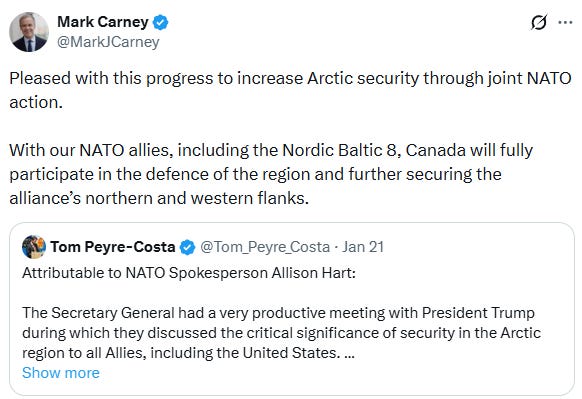
However, Prime Minister Carney’s comments at Davos suggest a potential thawing in this long-frozen position. And lest anyone assume his statement during an unscripted Q & A wasn’t an intentional policy change, the Prime Minister posted this to X on Thursday:
“Pleased with this progress to increase Arctic security through joint NATO action.
With our NATO allies, including the Nordic Baltic 8, Canada will fully participate in the defence of the region and further securing the alliance’s northern and western flanks.”
Why Carney has chosen to open the window to a larger NATO‑structured footprint in the Arctic is not entirely clear.
It’s possible that Trump’s attempts to seize Greenland have convinced the Prime Minister that similar efforts are likely to target the Canadian Arctic soon, and that the benefits of deeper NATO involvement outweigh the risk of weakening the perceived legitimacy of Canada’s claims.
Alternatively, Canada’s expanding Arctic capabilities - nine Arctic-capable icebreakers have been commissioned in Canada since 2018, and 26 more are in the pipeline - may have convinced Carney the country now has sufficient capacity to support a NATO presence while still maintaining distinct sovereign mechanisms to enforce its claims.
A third possibility is that, in the current geopolitical climate, the Prime Minister sees an opportunity to be more ambitious. Perhaps this is part of an attempt to finally nudge the United States and other NATO allies toward recognizing Canada’s legal position on its Arctic claims.
One of the driving concerns for President Trump and, by extension, the United States in its efforts to gain sovereignty over Greenland has been its apparent concern over Chinese and Russian influence and presence in the area. While the exact validity of Trump’s claim that “Right now, Greenland is covered with Russian and Chinese ships all over the place” is dubious, and other motives are likely in play, concern over Russian and Chinese presence in the region seems genuine.
Here, the longstanding American position on the Northwest Passage begins to look awkward. If the passage is an international strait, then Russian and Chinese vessels—including warships—would enjoy an established legal right of transit through waters that are strategically adjacent to, and arguably analogous with, those off western Greenland.
This creates a rare moment in which a traditional US legal stance sits uneasily alongside the concerns which are driving its policy decisions. It may not take much of a push to prompt a reassessment - which could lead to formal recognition of Canada’s Arctic claims by the United States. A shift that would likely outlast the present US administration.
Ironically, the current US administration’s relative indifference to legal consistency - generally a cause for concern - may actually work in Canada’s favour. Where previous administrations insisted on maintaining scrupulously coherent positions across all international waterways, this one may care less about accusations of hypocrisy so long as it perceives a net strategic benefit. The ability, with a close ally like Canada, to keep Chinese and Russian ships out of the Northwest Passage when desired is a net strategic benefit.
Seen in this light, Canada’s newfound openness to a NATO footprint in the Arctic could be a pre‑emptive hedge ahead of such an effort to nudge the US in that direction. There’s inherent risk in drawing Trump’s attention to a potential Russian or Chinese threat but, as with Greenland, the best mitigation strategy is to be able to stand tall with allies.
Alternatively, this openness could be intended as a carrot offered to both the United States and Europe, signalling that Canada’s enthusiastic cooperation in a NATO‑based Arctic security framework is available in exchange for stronger guarantees of Canadian Arctic interests.
Whatever the precise motivation behind Carney’s remarks, they point to a quiet but meaningful shift in Canada’s Arctic posture. For decades, Ottawa has treated NATO involvement in the Arctic primarily as a latent threat to sovereignty rather than a potential instrument of it. To clumsily - but deliberately - re-re-use Havel’s allegory, Carney may have taken down the sign in the window that reinforced this orthodoxy, and discovered an open window of opportunity behind it.
For a long time, there was an idea of "Arctic Exceptionalism" which sought to look at the Arctic as a non-military region of political cooperation, including cooperation with Russia. This is similar to how Antarctica has been viewed under the Antarctic treaty, although that is changing with increased Chinese activity.
If you look back at the Canadian reaction to then Secretary of State Pompeo's 2019 speech around the time of the Arctic Council meeting (in which he brough security to the forefront, speaking clearly of Russia and China), you will find criticism that the speech 1. Failed to mention climate change (although ti did mention CO2 reduction) and 2. It mentioned the US view of the Northwest Passage. (although Pompeo clearly said that the NWP wasn't a serious issue, that there was an ongoing detente regarding it, and that Russia and China were both far more important to security than the NWP (and the US-Canada Arctic border dispute).
Other reactions regarding climate change were similar. The general idea was that Arctic security was not an appropriate subject for discussion at the Arctic Council (or even elsewhere), as it might jeopardize Russia's participation is shared climate agreement (such as regarding black carbon).
Another excellent article, Policy Hawk. The defence initiatives pertaining to the Arctic are finally underway, decades later.