


This morning’s military raid by the United States inside Venezuela to capture Nicolás Maduro Moros is likely to have wide-reaching implications. From a Canadian perspective, many of those implications are related to oil. Let’s see if we can parse them.
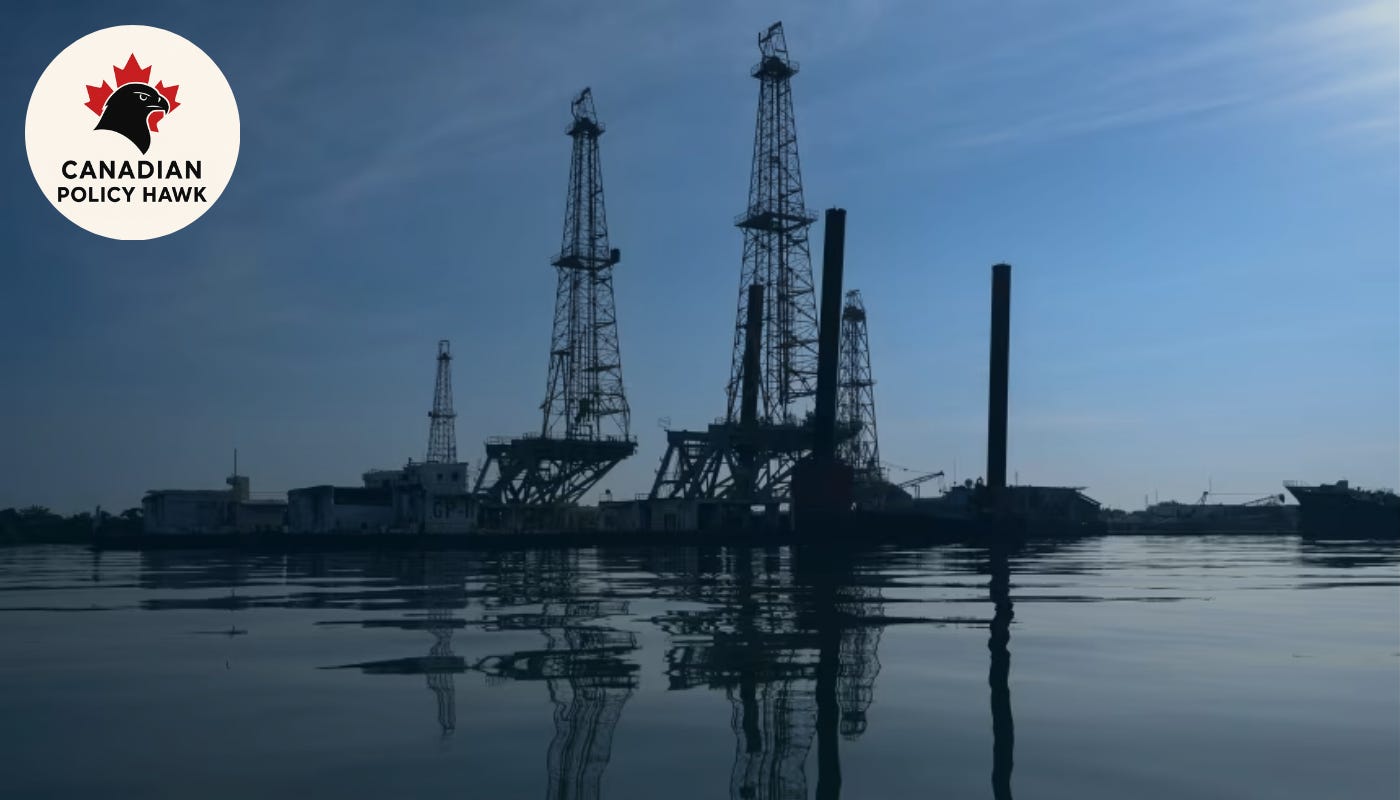
First, we should be clear: this intervention is about oil. Unlike past US military actions against oil-rich states (e.g. Iraq), there is no pretense that the US does not intend to benefit directly from the Venezuelan oil industry.
This was made clear in December when Trump said Venezuela must “return to the United States of America all of the Oil [...] that they previously stole from us”.
And it was reinforced today when he said America would be “very strongly involved” in Venezuela’s oil industry.
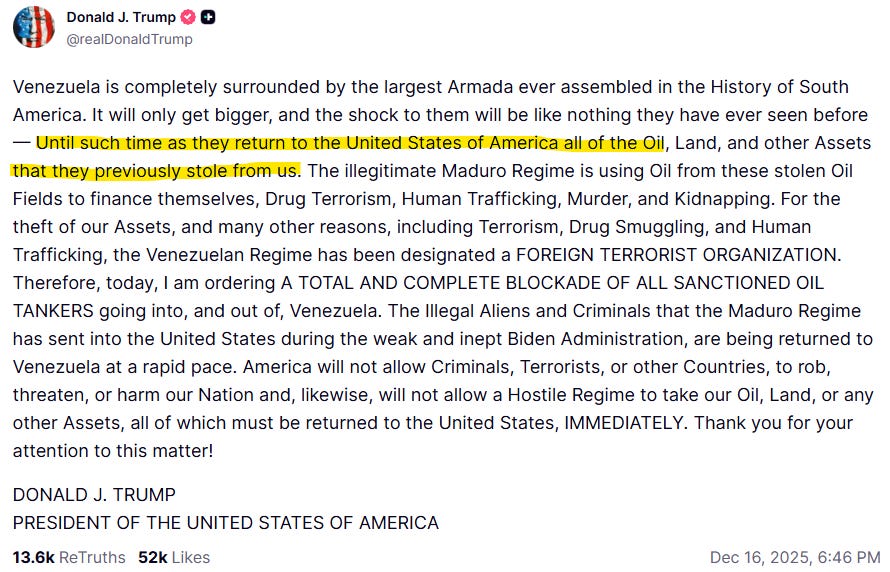
Some argue oil is not America’s primary motivation here. But that distinction doesn’t really matter. Whether oil, drugs, or Maduro stealing one of Trump’s red ties was the catalyst, if the outcome is US seizure and control of Venezuelan oil, then this is about oil.
Of course, capturing Maduro does not itself give the US control over Venezuela’s oil infrastructure. That would require further action. But, Trump’s statement today that America is “going to run” Venezuela, at least in the near term, suggests that action is pending.
Why US control of Venezuelan oil matters to Canada is simple: Canada is currently America’s largest supplier of crude oil, exporting roughly 4 million barrels per day (bpd), worth about US$130 billion annually.
And Venezuelan oil is a direct substitute.
It is not always appreciated that oil refineries are built to process specific blends of crude with particular chemical properties. In general, they cannot easily switch from one source to another without being largely rebuilt.
Canada and Venezuela are an exception to this. Our crude oils are easily interchangeable.
That raises the possibility that a US-controlled Venezuelan oil industry, optimized for American benefit, could displace Canadian exports.
There are signs this is seen as a feature, not a bug, in US policy circles.
Today, Katie Miller (wife of Trump adviser Stephen Miller) shared a post on X that quoted someone saying “The US doesn’t need Canadian oil anymore” and added the comment “Free trade is over”.
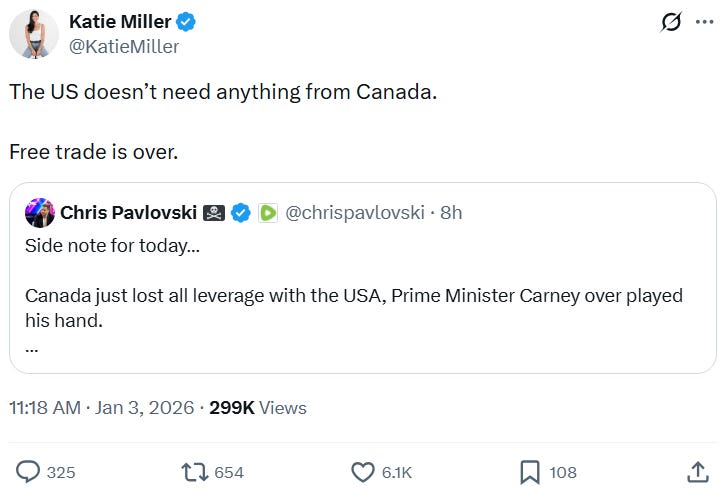
This also aligns with Trump’s statements and actions.
Whatever goal he was trying to achieve with his tariffs of Canadian goods, Trump’s hand was obviously restrained by America’s dependence on Canadian oil. It’s entirely consistent that he would want to break that leverage.
This brings us to an important question: how easily could Canadian oil exports be replaced by US-directed Venezuelan production?
The answer depends on timelines - but it’s a major challenge for Canada.
The lowest hanging fruit for an America committed to this goal is the Canadian oil currently refined on America’s Gulf Coast. All the numbers in this piece are rough, but 450k bpd (11%) of the 4m bpd Canada exports to America eventually flows there.
Replacing this would be straightforward. Venezuela produces 900k bpd now, and there’s no logistical challenge to bringing it to the US Gulf, offloading it, and refining it in place of Canadian crude. Barring outside factors (e.g. an insurgency) this is probably cheaper too.
Using the balance of Venezuela’s oil production to offset Canadian imports is more complicated, but seems plausible.
Most Canadian crude is refined in the US Midwest. Current infrastructure moves petro products south from there - not crude oil north to it.
However, if existing pipelines cease carrying Canadian oil south to refineries on the Gulf Coast, the option exists to reverse them to carry Venezuelan oil north. Barging oil up the Mississippi is also an option.
These options take time and capital, the cost of which would need to be amortized into prices. That reduces, but probably doesn’t eliminate, the cost advantage Venezuelan oil enjoys. Meaning this could be an economically appealing option.
US oil companies may initially be Canada’s ally in resisting this. Stability of supply is critical, and potential Venezuelan political turmoil - or US policy reversals by future administrations - pose risks if they convert their infrastructure to rely on Venezuelan oil.
But if Trump can demonstrate stability in Venezuela’s oil sector, and if Democrats tacitly acquiesce, reducing reversal risk, those barriers fade.
Trump also has regulatory and political tools to force the issue.
Even without major infrastructure changes, US refiners have another option. The Gulf Coast has spare refining capacity for this type of crude. They could refine more there and less in the Midwest.
That would require moving refined products north into markets currently supplied by Midwestern refineries. It’s not trivial or easy to scale - but the infrastructure to do it can be built gradually and non-disruptively, exporting excess refined product in the meantime.
Maintaining market share under these conditions would put heavy downward pressure on Canadian crude prices. Canada would lose revenue both from lower volumes and lower margins.
Having more than 20% of Canadian oil exports threatened is a serious issue. But there are partial mitigations.
This outcome requires redirecting all Venezuelan oil to the US - leaves existing customers needing new suppliers.
These customers are not the reliable international partners Canada would prefer to sell its oil to - China is the largest - but neither is the US if they’re intentionally pursuing this policy. In that sense, it’s trading one unreliable partner for another.
Those countries have been receiving Venezuelan oil at a steep discount, thanks to US tariffs. They’d prefer a lower cost supplier.
Still, the fact that China buys a significant percentage of the crude Canada gets to tidewater today suggests they may have few other options.
The challenge, of course, is getting oil to tidewater.
Canada is less constrained in this regard than it once was. The Transmountain Pipeline expansion was recently completed (Thanks Trudeau!) and increased its capacity from 300k to 900k bpd.
Most of that capacity is already in use, which makes it part of the “status quo”. But it still provides a buffer and option that wouldn’t have been available a few years ago.
It’s also been reported that TMX can expand capacity to 1.25m bpd within the 5 years. Let’s do that.
Canada also has unused crude-by-rail capacity. Rail is more expensive and less safe than pipelines, but shipments peaked above 320k bpd in 2019. Recently they’ve been under 100k bpd. That’s 200k bpd of transport capacity that we can use.
These are stopgaps. To seriously address the scale of this challenge, Canada needs at least another 500k bpd of pipeline capacity to tidewater within five years.
The construction is feasible. The planning, permitting, and consensus-building are harder.
All of this would - imperfectly and at significant cost - mitigate the risk of US-directed Venezuelan oil displacing Canadian exports at existing production levels.
However, that’s not the full extent of the risks facing Canadian exports.
While today Venezuela exports less than a million bpd of crude oil, it retains the largest proven oil reserves anywhere, and its peak exports were over 3m bpd.
That is a volume of oil Canada could not find alternate export routes for in under a decade.
However, US ability to restore Venezuelan oil industry those levels is also constrained, and likely a decade-plus project itself.
The reason is that Venezuelan oil production isn’t shut down, it’s atrophies, and that’s hard to reverse.
The reason for the diminution of Venezuelan oil production is linked to a 70% drop in the global price of oil that happened in the middle of the 2010s. While Venezuela was a true petro-state, with no major secondary industry to buffer its revenues during the downturn.
Without money, maintenance was deferred or done to a low standard. Infrastructure failed. Output fell. Revenue fell further. The cycle repeated.
The Venezuelan government reportedly used coercion to get more, and cheaper, output. But the issue was the machines, not the people. And machines are notoriously non-responsive to coercion.
Meanwhile, the engineering and technical talent that had been built up over decades and sustained the industry decided they’d rather work somewhere else and went to countries where working conditions were better and their skills were valued. Many came to Canada.
Eventually, Venezuela stabilized production at a level it could maintain without the lost engineering and technical talent, by using its creative motivational methods. But vast amounts of unused oil infrastructure was left to rot. It can’t be turned back on, only rebuilt.
The best people to do that are the engineers who previously fled the country. Some may be willing to return, particularly if doing so is seen as helping their nation. But these are smart, educated people, who won’t be fooled if their work is designed to only benefit the US.
They’re also unlikely to return in sufficient numbers unless the coercive systems that drove them out end.
Yet those systems are central to sustaining even today’s production levels. Reforming them has consequences.
The entire industry is likely in a “J curve” scenario. Where it can’t easily produce more using the systems it has, but changing those systems will actually reduce output before they can climb to greater heights on the other side of the curve.
Whether the US wants, or can afford, to support Venezuela through that transition is unclear. Its competence to do so is also an open question. The “J-curve” concept was first developed in the context of work America had to do in Iraq, showing success is not guaranteed.
For Canada, that means large-scale Venezuelan expansion is likely slow and visible. It’s something to watch for and decrease vulnerability to. But it’s not yet a crisis requiring immediate action.
By contrast, the redirection of existing Venezuelan production to displace Canadian oil in the US market could happen quickly.
Canada would be wise to start responding as if it’s going to happen now - before it’s trying to find solutions while impacted by the consequences.
Thank you for reading this piece! I’m genuinely grateful that you took the time.
I write long pieces about things I find interesting. However, work like this takes time and energy, and are easier to justify if they reach a large audience. If you found value in this, please take the time to like, share, and comment. You can even subscribe, for free or as a paying supporter!
If you’d like to support my work without the commitment of a paid subscription, you can also send me a one-time tip via Stripe, and buy me a coffee (or a little bit more).
Please don’t feel any pressure, all my work will continue to be available for free. However, earning a few dollars does make it easier for me to write pieces more often.
Thanks!
While I agree that this whole thing will eventually have wide reaching and ranging implications. There's also the intrinsic problem that Maduro's empire still hasn't fallen. They may have taken a hit. Yet, the fact that they still run the country, and also provide the security necessary, make any help by the USA unlikely at this time.
The atrophy of the O&G infrastructure within Venezuela will take at minimum 12 months with Billions of USD invested to just double the output and squeeze themselves to close to 2M bbl/day. It'll likely take longer as that estimate is generous. If you follow any of the Oil experts that are out there sharing their knowledge, you'll find that none of the Big US based Oil Companies are currently jumping at the opportunity. That comes down to security. Capitalists are VERY predictable. They will continue doing what they are doing as long as they're making money. Only when the math checks out will they take the risk. At this time, the risk factors are still far too high for them to jump at this opportunity. Until that risk factor in lessened, likely when there's a democratic govt running Venezuela, and they have the security they feel is needed. Then they will jump in.
The other factor that very few people are talking about is that Venezuela's oil is on the other side of a mountain range from tide water. We Canadians have a very clear understanding of how difficult it can be to navigate through mother nature's geography. It only makes rebuilding and expanded new construction that much more difficult.
Trump's move on Venezuela is explicitly about oil, and Canada's 65% share of US crude imports makes this a real threat. The article's analysis mostly holds up, but two things matter more than it suggests.
First, Venezuelan production recovery is a decade-long slog, not a near-term risk. The author correctly identifies the "J-curve" problem: infrastructure atrophied, engineers fled, and rebuilding requires sustained capital and stability. Current oil prices (~$57/bbl) don't justify the investment yet. Meanwhile, replacing Canadian crude at US Gulf refineries is straightforward—that 450,000 bpd displacement is the actual near-term risk.
Second, Canada's tidewater options are live now, not future mitigation. Trans Mountain finished expansion in May 2024 and already ships 525,000 bpd to non-US markets, mostly China. Chinese refiners have pivoted 850,000 bpd toward Canadian oil in response to US tensions. That cushions the blow significantly.
The real threat isn't immediate displacement but gradual repositioning over five-plus years as Venezuelan production slowly recovers. Canada should accelerate next-phase pipeline capacity while China remains a willing buyer. TMX is already working.