


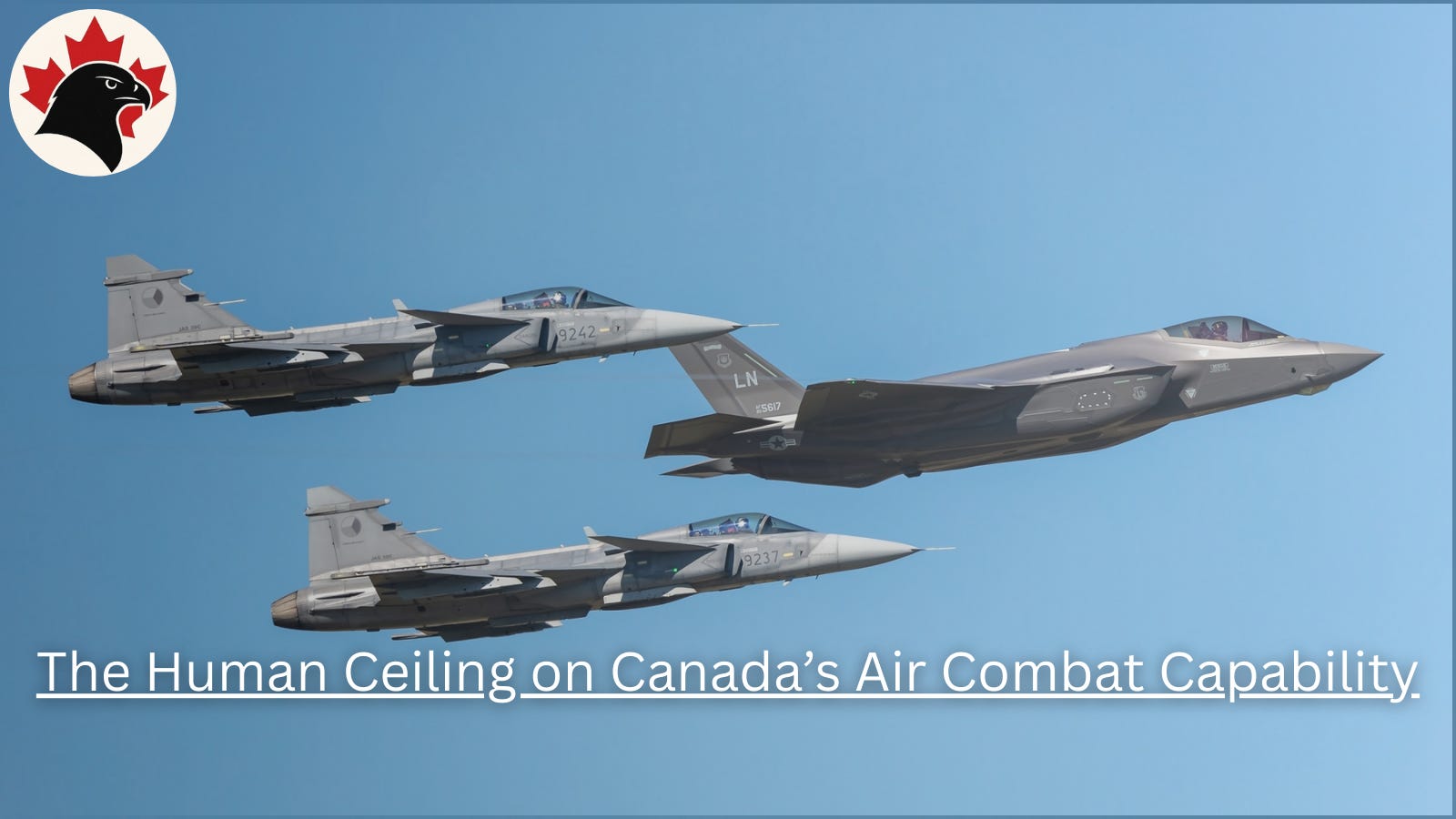
Despite the fact that one of the first acts of the Mark Carney government was to announce a review of Canada’s purchase of 88 Lockheed Martin F-35A Lightning II fighter aircraft, it remains all but certain that Canada will acquire at least some F-35s.
The leading reason for this is fairly banal: we’ve already paid for sixteen of them.
Neither Lockheed Martin nor the current U.S. government seems likely to provide Canada with an escape hatch that returns those funds, and the Government of Canada seems unlikely to write off a multibillion-dollar investment.
Still, the government appears to be seriously weighing - and there is significant public discussion around - the possibility of acquiring a complement to the F-35. Despite some speculation that the review has cast a wide net, speaking to European, American, and possibly some Southeast Asian manufacturers, both government comments and public discussion continue to assume that the most plausible alternative is Saab’s JAS-39 Gripen E.
I don’t want to rehash all the arguments for and against each aircraft here. If you’re reading this but haven’t followed the broader discussion, three excellent pieces that explore it are Philippe Lagassé’s “Fighters Passing in the Night” (a balanced overview), Hush Kit’s “Why the Gripen vs F-35 Debate Isn’t Really About Hardware or Software — It’s About Canada Refusing to Be a Vassal” (a strategic-sovereignty case for a mixed fleet), and this thread on X by Sam (a technical case for the F-35).
In watching - and participating in - the public discussion, I’ve noticed something curious. Proponents of a mixed fleet write long arguments on the strategic, operational, industrial, and sovereignty merits of the concept. While those who favour a pure F-35 fleet are much more likely to focus on a single issue: personnel. The F-35 proponents focused on personnel are also far more likely to be current or recent members of the CAF.
I don’t subscribe to the occasionally floated idea that the CAF should have complete autonomy over defence spending. But it would be foolish not to listen closely to the concerns of CAF members when making defence investments. So when personnel is repeatedly raised by CAF members, even if rarely elaborated upon, it makes me wonder:
What can we infer from public information about the personnel challenges facing Canada’s fighter capability - and how would a mixed fleet affect them?
At the risk of stating the obvious: both the CF-18 and its possible replacements require pilots. Pilots can learn basic skills in other aircraft, study theory in classrooms, and spend time in simulators. But they must also spend at least some real-world hours in the aircraft they will fly in combat.
A 2018 Auditor General report gave us a useful benchmark for that: the minimum number of hours the RCAF says a fighter pilot must fly to retain proficiency is 140 hours/year. That same report noted that many CF-18 pilots were not hitting this target due to aircraft unavailability - an issue it noted was rooted largely in technician shortages and a decline in average technician experience.
A 2019 Parliamentary Budget Officer report told us that Canada’s CF-18s were flying ~160 hours per aircraft per year.
This figure is now dated to just be accepted as still representative, but we know that by 2016 the average CF-18 had accumulated 6,000 of its 8,000 expected flight hours. The ex-Australian F-18s acquired in 2019 also had roughly 6,000 hours of flight time. Given those starting points, the 8,000 life expectancy, and the fact that Canada plans to fly the CF-18 until 2032, 160 hours per year per jet is almost certainly an upper limit of how much they may be flying today.
The purpose of these numbers is to determine an upper bound on how many fighter pilots the RCAF could possibly keep proficient. To do that, we also need the number of operational fighters generating those hours. This number is shockingly difficult to obtain with precision, but using the highest reasonable estimate - 95 aircraft - we can calculate the theoretical maximum number of pilots who could meet the RCAF’s proficiency requirement within the RCAF.
That number is 108.
To be clear, that is the maximum possible number of proficient pilots the RCAF can maintain at once, assuming perfect allocation of flying time. Realistically, not all 140 hours are interchangeable: some pilots may meet the total but miss specific skill requirements; others may need more attempts than planned to meet performance thresholds.
Training is also going to drag down this number, at least in terms of combat qualified pilots, as both new pilots and pilots returning to fighter squadrons from other posts require additional flight hours being combat qualified.
While the fact that pilots rotate to other posts and back into the fighter squadrons implies that the RCAF may have some additional depth beyond the squadrons themselves, the 108 figure still represents the bulk of Canada’s fighter pilot capacity - and again, it’s a best case.
Considering these factors, it seems almost certain that Canada has fewer than 100 combat-qualified fighter pilots, and it wouldn’t be especially surprising if the number were closer to half that.
What this reveals is a fragile personnel structure. Losing even a single-digit number of pilots will significantly impact capacity. In some specialized roles - such as instructors, tactics officers, flight leads, squadron commanders - a handful of individuals may represent the entire available pool of those qualified for the role.
This is the backdrop against which we must view the challenges of choosing a multi-fighter fleet. Several experienced fighter pilots have reportedly already left CF-18 squadrons to transition to the F-35. We don’t know how many, but we do know that they are generally the type of experienced pilots who are most scarce, because they will form the instructor cadre and initial leadership for the Canadian F-35 community.
Adding a second fighter type would require a doubling of the number of experienced pilots to leave CF-18 squadrons for these purposes. If Gripen is selected as a second aircraft, and it arrives on the timeline being publicly discussed - three to five years - this group of officers must be identified and removed from CF-18 units soon - meaning the personnel demands required for a Gripen fleet transition would be felt in parallel, rather than in sequence, with the demands of the F-35 fleet transition.
There is no way that this doubling in the pilot-drain from CF-18 squadrons wouldn’t negatively impact the effectiveness of those squadrons. A reduction in effectiveness which will bite while they’re still our only operational fighter force - which is the plan until at least 2029 - and continue through the remainder of their operational life which isn’t expected to end until 2032.
The challenges to CF-18 squadrons would extend beyond just those caused by this pilot-drain. The RCAF will also need to pull experienced technicians from CF-18 squadrons to retrain on new aircraft. As with pilots, the first group must be composed of the experienced maintainers, who will become the trainers and leaders in their roles for the new fleets.
The 2018 Auditor General report emphasized technician shortages and declining technician experience as risk factors for CF-18 fleet effectiveness at least on par with the risk created by pilot shortages. It noted that recent losses of experienced technicians had increased maintenance hours per flight hour from 21 to 24, and that aircraft availability fell correspondingly.
Earlier we calculated pilot flying hours based on the number of aircraft in the fleet. But the true limiting factor is maintenance; both how many technician hours are available and how many technician hours are needed to complete a job. Removing experienced technicians reduces both sides of the equation: the number of hours available for maintenance decreases, while the number of maintenance hours required for any given job increases.
In a force with so little redundancy, this combination could easily reduce aircraft availability to the point where maintaining proficiency across all required roles becomes impossible - meaning the fighter force would, in at least some respects, no longer be combat capable.
So why not fix all of this by training more pilots and technicians?
Three reasons.
First, pilots and technicians don’t grow on trees. That’s a phrase sometimes used when something isn’t abundant, but its original intent was to refer to when the process to create something isn’t abundant. That’s the case here. As we established earlier, pilots need flight time, which is capped by the number of aircraft. Technicians also need to be trained on the aircraft they’re going to maintain and service, and aircraft numbers limit capacity for that as well.
Second, expanding the training pipeline for pilots and technicians before they reach the squadrons requires the same experienced pilots and technicians whose shortage we’re trying to solve. In the short term, increasing training throughput actually intensifies those challenges.
Third, anyone recruited today will have limited impact during the transition. The acute personnel pressures of the transition period - whether to one aircraft or two - will peak over the next decade. The people who are most in demand during that transition are those who already have ten years’ experience. There’s no short-cut which gets today’s recruits 10 years’ experience during this transition. So, while recruiting new personnel today is essential for the post-transition future, it does little to ease the bottleneck between now and 2035.
So what can we conclude?
Those raising “personnel” as an obstacle to a mixed fleet have a legitimate concern. It is reasonable to claim it’s not just a challenge, but the binding constraint of a mixed fleet proposal.
Does this make it so significant that a mixed fleet is impossible? That’s a claim I’m not prepared to make.
But the challenge is large enough - and the solutions unclear enough - that any mixed-fleet proposal must grapple directly with personnel constraints. Any proposal that doesn’t grapple with them - whether that be through a plan for addressing them, or an acknowledgement and acceptance of the trade-offs those challenges create - is not a serious proposal.
A mixed fleet may not be impossible. But it’s not free. And any discussion which fails to acknowledge that is leading us away from the best course instead of towards it.
Fin.
Thank you for reading this piece! I’m genuinely grateful that you took the time.
If you happened to find this article through X, or have an account on X at all, I’d be very grateful if you would return there and like/share the top post on the thread there. I’m still extremely new to Substack, and would appreciate the help ensuring my writing reaches as many people as possible.
Also: If you’re not subscribed to me here, I’d love to have earned your subscription today.
As a former CF-18 pilot myself, I am also concerned about the current shortage of both trained fighter pilots and technicians. It is true to say two fleets would come with a personnel cost beyond that required for a single fleet, even if the total number of new fighters was the same. Two thoughts:
1). The Armed Forces, including the Airforce and fighter force must be rebuilt. We have heard discussion in the news recently related to increasing the size of the Supp and Primary Reserves to a combined 400,000 personnel. To date, there has been nothing said about the size of the regular force. To my mind, given the uncertain geopolitical circumstances and anticipated 5% GDP spending, the Government is long overdue telling Canadians how big (in numbers) an Armed Forces our annual $150B expenditure will buy. To my mind the service needs to expand from the 65,000 currently authorized today to at least 130,000 or better 200,000. In this scenario, the fighter force would consist of at least 10-12 front line squadrons in addition to training squadron(s). This force structure would require a fleet of 150-200 fighter aircraft and about 225 - 300 fighter pilots. This should be the goal. To achieve the numbers stated above, the Armed Forces will need to become an ‘employer of choice’. Pay, benefits, opportunity. Definitely challenging given the ‘hole’ we are starting in.
2) Your article does a good job highlighting the connection between annual CF-18 flight hours available with the number of pilots that the existing fleet can support. You based your figures on total flight time available per airframe and the time the CF-18 must remain in service (as the RCAF did recently when deciding how many aircraft to upgrade). With a new fleet of aircraft however, the constraints affecting flying time for training changes; the limiting factor becomes aircraft ‘availability’ (serviceability rate), cost per flight hour and budget allocated. As I see it, a real issue with the F35 is its stubbornly low availability rate (35%) and its shockingly high cost per flight hour ($49,000 CAD). To put these figures in perspective, this is an availability rate lower and a cost per flight hour much higher than the that of our tired old CF-18. Based on standard ‘rules of thumb’ these numbers suggest that our brand new fleet of F35s could only support the training of about 100 pilots - sufficient for today, but well short of what our future force requires. The exact number would depend on how many hours you wished to allocate to each pilot for training annually.
An excellent article! As an advocate for a mixed fleet of fighters and having read numerous articles about same I had not even considered the challenges of pilot training and retention, required flight hours and the unsung dedication of ground crew technicians for current and future aircraft fleets.