


On Wednesday, the Government of Canada announced its first investment under the Canadian Defence Industry Resilience Program—part of the Defence Industrial Strategy released just a month earlier. The package includes $1.4 billion in contracts to two existing munitions suppliers to expand artillery ammunition production.
These contracts are long overdue. The war in Ukraine has demonstrated, decisively, that artillery remains central to modern warfare—and that large-scale combat can consume ammunition at staggering rates.

At the outset of the war, Canada’s artillery production capacity was modest. Efforts in 2022 and 2023 increased output somewhat, but key limitations remained: facilities were not configured to produce some of the most in-demand shells and charges, existing facilities had inherent expansion limits, and many critical components weren’t made in Canada at all but were imported from the United States. Wednesday’s announcement takes meaningful steps toward addressing all three of these limitations.
Not everyone is happy with this investment however. Former Conservative Party of Canada Leader, and CAF veteran, Erin O’Toole was among the quickest and highest profile critics, saying, “First test of the new Defence Industrial Strategy gets a failing grade. This is not a sovereign solution at all.”
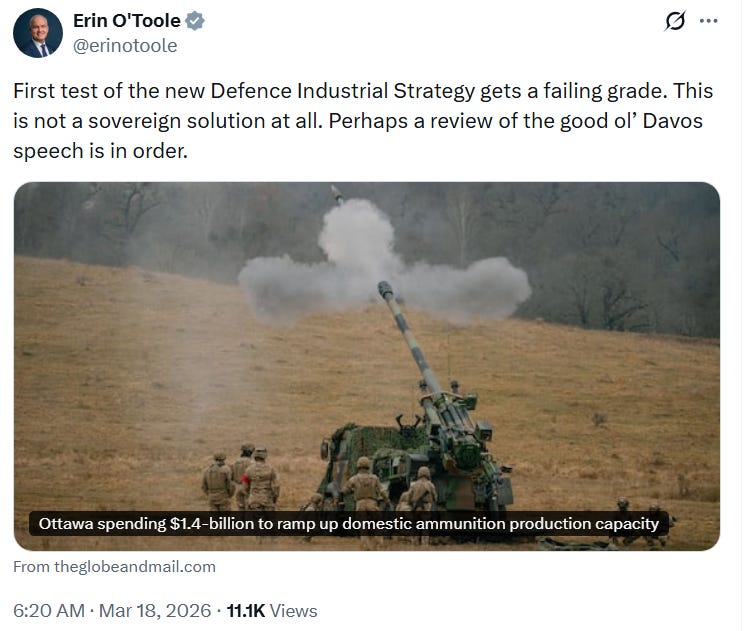
Mr. O’Toole’s criticism is rooted in the fact that the announcements provides $355.7 million to construct a facility to produce nitrocellulose, which is a material used to make the case of propellant charges combustible, to General Dynamics Ordnance and Tactical Systems - Canada (GD OTS-C) — a Canadian subsidiary of US-headquartered company.
This raises a fundamental question: if the goal is to build a stronger Canadian defence industry, what counts as Canadian?
There is a strong case that GD OTS-C is a very Canadian company. It has operated in Canada since 1989, operating facilities and providing capabilities that in some cases date back to the Second World War. It is headquartered in Quebec and is one of just five firms in Canada’s Munitions Supply Program—designed explicitly to “secure a national capability for the supply of critical ammunition.” Treating it as a domestic supplier is not a new precedent.
This case is made stronger when considering some products that Canadians think of as their own. Most would consider the Canadian Army’s main infantry fighting vehicle, the LAV 6, to be Canadian. The same is true for the CL-600 business jet, the iconic CL-215 waterbomber, and the CT-114 Tutor that the RCAF’s Snowbirds have used to represent Canada for decades. Yet all were developed by Canadian subsidiaries of American companies—indeed, in these cases, the subsidiaries that originally made them or make them today are owned by the same parent company that owns GD OTS-C. Ultimate ownership alone has not historically disqualified something from being considered “Canadian.”
This is not to dismiss Mr. O’Toole’s argument. All else equal, preferring Canadian-owned firms for contracts intended to strengthen domestic industry is entirely reasonable. Drawing a bright line around ownership is a principled position. But it may not be a practical one.
GD OTS-C is not simply “one of” the companies supplying components for Canadian production of artillery ammunition. For most of the work it does, it’s the only domestic producer. Other manufacturers could learn what they already know, but projects requiring them to do so would take longer and cost more.
If a project that GD OTS-C can complete in two years for $300m will take four years and cost $500m with another company, some might argue that it’s worthwhile to use a Canadian-owned company. But what if the timeline is ten years, and the cost is $2b? At some point, the principle breaks down.
This is especially true when it is just a principle. Even if another company builds and operates a nitrocellulose facility, GD OTS-C is still the only company contributing other components to the capability being built — artillery shells and charges. Under current arrangements, the nitrocellulose is going to them for assembly. Zero potential vulnerabilities are removed, and zero sovereignty is gained, by having that one facility operated by someone else.
This isn’t a unique scenario. Of the five companies within Canada’s Munition Supply Program, only two are ultimately Canadian owned. They all do work, and have experience, that’s unique within Canada. That reality is representative of the entire Canadian defence industrial base. Rejecting companies from projects based on their Canadian-ness will come with significant costs.
And ownership is only one dimension of “Canadian-ness.”
Take Magellan Aerospace, one of the two Canadian-owned firms in the Munitions Supply Program. It is headquartered in Mississauga and majority-owned by a Canadian billionaire. Yet its most recent financial statements show that it has a larger share of its long-lived assets — its means of production, like, land, plants, and equipment — in both the United States and Europe than in Canada. Canada is ranked third.
So which is more “Canadian”: a domestically owned firm with a globally distributed industrial base, or a foreign-owned subsidiary whose assets and production are overwhelmingly in Canada?
The question becomes even sharper in practice. If Magellan were to fulfill a Canadian contract using U.S.-based production — something the exports section of their statements indicates they do — while GD OTS-C delivered entirely from Canadian facilities, what should matter more? Ownership? Or where the work gets done?
The point is not to argue against firms like Magellan, which are vital contributors to Canada’s defence industry. It’s to illustrate that firms are rarely Canadian in every sense, that many competing factors are at play, and taking an absolute stance on just one factor won’t lead to the best outcomes.
The Government of Canada has, for now, chosen a broad interpretation of what qualifies as “Canadian.” Eligibility requirements for the Canadian Defence Industry Resilience Program can be found here. There’s a legitimate debate to be had around whether they set the requirements in the best place.
But there’s a real danger, if we’re not considering these issues deeply and with some level of practicality, that we’ll insist on definitions of Canadian-ness so narrow that it makes effort to expand the industrial base unworkable. There are very few defence firms operating in Canada at the scale required to take on major defence projects that are “Canadian” in every conceivable sense.
What Canada needs is a mature discourse around defence which helps decision makers to navigate these issues. One that understands the trade offs, and can give them direction on whether it’s more important to have ownership be Canadian, or for the means of production to be within Canada. And what kind of premium in time and money is reasonable to use more Canadian suppliers.
Canada does have the power to make choices in how it grows its defence industrial base. But it does not have the luxury of pursuing purity. Because Canada can have a defence industry that is purely Canadian—or one that actually works. It should be careful not to choose the wrong one.
If you love my work and want to support it, please like, share, and comment. You can even subscribe, for free or as a paying supporter!
If you’d like to support my work financially without the commitment of a paid subscription, you can also send me a one-time tip via Stripe, and buy me a coffee (or a little bit more).
Please don’t feel any pressure, all my work will continue to be available for free. However, earning a few dollars does make it easier for me to write pieces more often.
I checked the eligibility criteria at https://www.canada.ca/en/department-national-defence/programs/canadian-defence-industry-resilience/eligibility.html. The program funds any corporation incorporated in Canada that runs operations here. No full ownership test required. That greenlights the $355 million nitrocellulose upgrade at General Dynamics in Quebec. It builds the sovereign ammo supply Minister McGuinty announced. National Defence committee hearings last year showed why speed matters. Real production here beats waiting for perfect ownership.
Baby steps