


Today, it was announced that 2026 will mark the end of the CT-114 Tutor’s time within the RCAF. The venerable aircraft entered service as a primary trainer in 1963 and was first used for aerobatic display during the 1967 centennial. It returned to that role in 1971, when the iconic Snowbirds air demonstration team was established, and has continued in that role ever since. After 2000, when it was retired from use as a primary trainer, the Tutor’s only flying role within the RCAF has been as an aerobatic performer.
The plan for the Snowbirds is that they will not tour for several seasons after 2026, before returning at some point in the early 2030s flying newly acquired CT-157 Siskin II turboprop aircraft. The Siskin II is already being acquired as part of Canada’s Future Aircrew Training Program, filling a similar niche to the one the Tutors were originally acquired to fill, and the intention appears to be to add aircraft onto the existing 19-plane order to meet this additional requirement. One interesting piece of phrasing from the press release states that this “will ultimately rebuild to the team’s distinctive nine-plane formation.” The word “ultimately” suggests that the team may initially include fewer than nine aircraft when it returns.
The choice to suspend Snowbirds’ performances until a new aircraft is available is one that I agree with, and have previously argued for. There have been safety issues with their ejection system that, reportedly, have not been addressed, and which contributed to the death of a non-pilot team member in 2020. The RCAF is also going through its largest recapitalization effort in decades, and experienced personnel are both in short supply and required to make those projects successful. The Snowbirds require disproportionately experienced personnel to operate and, as they fly an aircraft that’s now unique within the RCAF, those personnel lose proficiency that’s valuable in other units while assigned to the team. It simply doesn’t make sense to prioritize the team’s performances over more directly combat-relevant needs under those circumstances.
While I may agree with the decision to suspend Snowbirds performances until the Tutor can be replaced, I do not agree with the decision to replace it with the Siskin II — a turboprop plane — rather than a jet. The rest of this piece is going to be much more subjective and, frankly, personal than anything I’ve written here before. If that’s not why you read my work, that’s completely fair — expect more concrete analysis in the future. But the arguments for having the Snowbirds at all are also subjective and, in many cases, personal. Even seemingly rational arguments in support of them — like the claim that they improve RCAF recruitment — are only tenuously supported. I can’t find any record showing that someone has actually studied that question. In the end, Canada has the Snowbirds because Canadians like the Snowbirds. So discussing this topic in terms of why I, as a Canadian, like them doesn’t seem inappropriate.
Explaining why I like them requires me to start with baseball cards:
When I was around seven, I started collecting baseball cards. I knew very little about them, but my older brother collected baseball cards, and I didn’t want to be left out. One day, while picking out some of my cards to put into sleeves my parents had bought me, my brother saw a card of George Bell and told me I should sleeve it because it was worth protecting. I took his advice, not knowing why. That George Bell card happened to be part of a theme design that I only had a few of. The next time I came across a card with that design, I went to my brother and asked him if it was worth protecting too. He told me no, that it wasn’t the design that made it special, it was the player. I remember understanding this, but as I went through the rest of my cards, I still singled out cards with that specific design to go and ask him if they were valuable too. Having one special card with a feature I could identify made them all special to me.
In the years that followed, I learned a lot more about baseball and baseball cards. I now know, in my head, that my brother was wrong. My George Bell card wasn’t anything special, not in terms of value or interest to anyone else, and neither were any of the others with that design. But even though I haven’t looked at my cards in at least a decade, I know that the binder I keep them in has that George Bell card first, followed by every other card in that theme design, and that I couldn’t tell you what the next — presumably most financially valuable — card is. And I wouldn’t have it any other way. That’s the power of formative experiences; they can make things valuable to you in a way that doesn’t have to make sense in any objective way.
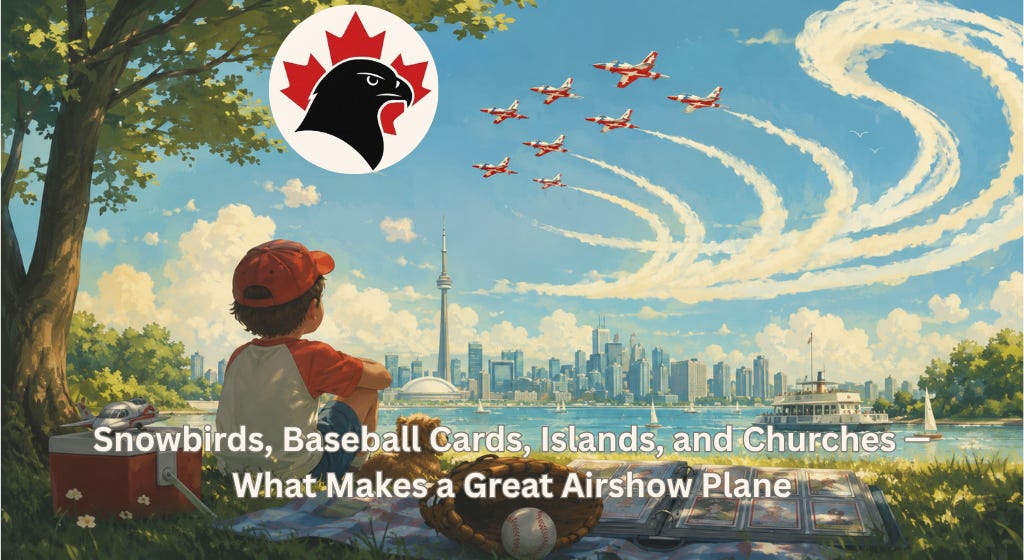
By the time I was seven, I’d also been to many airshows… sorta kinda. We couldn’t usually afford tickets, even though my dad — who’d been a private pilot before I was born — loved planes. So my family would pack a picnic lunch and go somewhere nearby where we could see the planes at least some of the time. My formative experience with airshows — the thing I remember doing year after year — was taking the ferry out to the Toronto Islands every Labour Day weekend, setting up on Hanlan’s Point Beach, and watching planes across the water at the CNE.
I always enjoyed seeing the planes from that beach, but the view of many of the performances left a lot to be desired. The CNE was centre stage, and performances that could be kept close-in were. Our view wasn’t blocked, but most acts were far away, relatively quiet, and clearly weren’t intended for us, so I spent at least as much time playing in the water and building sandcastles as I did watching them. The exception was the multi-jet teams — the Blue Angels, the Thunderbirds — I’d always watch those. And when I got bored with the beach and wanted to go home, my dad would remind me that the Snowbirds always performed last, and that the Snowbirds were always worth staying for. He was always right.
What was different about the multi-jet teams is that they couldn’t do their entire act close to centre stage. They had to spread out. That, along with the noise they made, meant that I felt like their performances were just as accessible to me as they were to anyone else. With nine aircraft that needed time to circle in from all angles, the Snowbirds’ show was more inclusive in this way than any other. By contrast, high-performance turboprop shows — even team performances — always stayed close to centre stage and felt like they were a private show for someone else. The multi-jet shows, and especially the Snowbirds, were something special.
Just as I went on to gain knowledge of baseball cards, I’ve gone on to gain experience at airshows. I’ve had the opportunity I didn’t have as a kid, sitting where the show is meant to be watched from. And I know, in my head, that all else being equal it’s objectively better when an entire performance can happen right in front of the intended audience. But my formative experiences still make the wide, sweeping shows that circle far away from the audience — the ones jets perform because they have to — the ones I get excited about. I always try to catch a glimpse of the aircraft wheeling off away from centre stage, waiting for their cue to return, because I know they’re passing above a kid like I used to be… and many others. I feel like I’m sharing the experience of a public show that’s accessible and inclusive, rather than a private one that excludes others.
The same brother who told me that my George Bell card was worth protecting went on to become a pastor. Once, when he was talking to another pastor in my family — I come from a family of pastors and pilots, sue me — I remember him justifying renovations to his church by saying that “architecture defines practice,” and that the his church’s building didn’t symbolize the values of the congregation, and needed to if the church was to thrive.
There’s a piece of wisdom in that idea that applies more broadly.
The Snowbirds are indisputably a symbol of Canada. And as Canada is a democratic society that values the principles of inclusiveness and accessibility. It matters that our symbols reflect that. If they don’t, why have them as symbols? Having the Snowbirds fly the Tutor, by nature of its flying characteristics, forced their performances to be inclusive and accessible — they could be enjoyed whether you paid for a ticket to the show or not. In switching to the Siskin II, I think that could be lost. I think that will be lost.
The issue isn’t that the Siskin II can’t perform the wide, sweeping show the Snowbirds fly today. In terms of performance, it’s nearly a match for the Tutor in most key metrics. The issue is that it doesn’t have to perform that type of show, and some fool with the best of intentions will decide that since it can perform a tighter, more centre-stage-focused show, it should. The architecture of the team (the aircraft) will define its practices (the show) and something will be lost without anyone knowing why. The show will become, in a sense, privatized — for paying customers only — which isn’t what a publicly funded national symbol should be.
Perhaps that’s too pompous a rationale. But the fact remains that I get excited to see the Snowbirds flying the Tutor, and I don’t — and don’t think I ever will — feel the same way about a turboprop. How I’ve arrived at that feeling is clearly personal. Most Canadians haven’t watched airshows from outside the fence or across the water. But even if my reasons for the feeling are uncommon or even unique, the sense of excitement I get from watching the Snowbirds is common. Whatever personal experience has led people to it, though it differs from mine, the feeling is the same. And I don’t think most of those Canadians will feel the same about a turboprop.
Of course, the argument that the Snowbirds should get a jet is irrelevant if there isn’t a viable option. The Siskin II was selected because Canada will already be flying it as a trainer, solving many of the problems tied to the Tutor as a single-purpose platform. It wouldn’t make sense to acquire a new jet solely for the Snowbirds, or to push a jet that’s otherwise going out of service into use by the team. Whatever fighter Canada ultimately fields will be far too expensive to justify in this role, and deliveries to combat squadrons must come first.
Fortunately, there’s another option. Since 2021, Canada has been looking to acquire a new jet through the Future Fighter Lead-in Training program. As the name suggests, these aircraft will be used to train new fighter pilots. There are logistical challenges in using them for the Snowbirds — fewer pilots and technicians would have experience with them by default — but it would still be an improvement over the Tutor as a completely unique flying platform. And while we don’t yet know what aircraft will be selected through this program, it will be a jet trainer that is suitable for aerobatic display. I’ve seen it suggested that the likely timeline for delivery through this project is around 2035, but if selection can be expedited, it’s possible that Snowbirds aircraft could be delivered first — keeping their return on an early-2030s timeline.
If Canada is going to pause the Snowbirds, it should use that time to get this right. Not just to replace an aging airframe, but to think seriously about what the team is supposed to be. The easy answer is that they are a recruitment tool or a public relations asset. The deeper answer is that they are something closer to a shared cultural experience — one that, at its best, doesn’t just belong to those who attend airshows, but to every Canadian who can look up. If that’s the case, then the aircraft matters — not because of raw performance, but because of what it encourages the team to do, and who it allows the show to reach.
There’s still time to choose an aircraft that preserves that spirit. A jet trainer acquired through the Future Fighter Lead-in Training program wouldn’t be the simplest or cheapest option, but it would be the right one. It would keep the Snowbirds fast, loud, and necessarily expansive — the kind of show that spills beyond the fence line and across the water. The kind of show that a kid on a beach, or a rooftop, or a backyard can feel just as much a part of as anyone else. If the Snowbirds are going to disappear for years — and they should — they ought to come back as something worth waiting for. Not just to those who already love aircraft, but to the ones who don’t yet know that they will.
Before you go! If you enjoyed this piece, please like it and share it.
This is my third piece in a week, which is a blistering pace for me. I’m doing this intentionally to test whether a faster pace of writing is something that’s sustainable for me. One thing that makes it sustainable is having a larger audience, so your likes and shares really do make a difference in what you’re likely to see from me in the future.
This piece is quite different from my other work, so whether you liked it or would rather I stuck exclusively to more analytical writing, let me know in the comments. I’m still relatively new to Substack and trying to figure out what I want to do here.
As always, I appreciate the support of everyone who subscribes — whether for free, or paid — and those who leave a one time tip to show appreciation without any form of commitment.
If you are from an organization that would like to discuss sponsorship or other significant support in exchange for recognition, please reach out via DM or by email at cdn.p.hawk@gmail.com.
I’ll also be at CANSEC May 27th and 28th, and would love to connect then.
Your writing has improved substantially.
Perhaps. At an airshow, most people won't care if it's a jet or a turboprop - except for one detail. The sound. Nine jet engines don't sound much different from one jet engine. Nine propeller aircraft will be a symphony in comparison. It will be sad to see the Tutors retired but I will probably grow to like the Siskins. I just need several to fly over my house like the Tutors did.