


When Canada’s Minister of Defence, David McGuinty, sat before Parliament’s Standing Committee on Defence this past Thursday and said “we’re good” when it comes to spending two percent of Canada’s GDP on defence this year, the response was predictably skeptical.
It was the same skepticism that has followed Prime Minister Mark Carney since his June 9th announcement of a $9.2 billion increase in defence spending, along with his assertion that 2025 would be the first year Canada meets NATO’s two-percent target - something it has never achieved since the guideline was introduced.
One reason for that skepticism is a belief that Canada simply lacks the capacity to spend that much additional money, even when it is budgeted. Government processes must be followed before budgeted funding can actually be spent and, in recent years, billions in budgeted defence spending hasn’t been spent when programs couldn’t fulfill the necessary requirements. That is an important and complex topic in its own right, but not the focus here. Perhaps it’s a topic for another time.
A second skeptical point of view looks at the promised spending increases and assumes they’re a cynical exercise which might show increased spending on paper, but which won’t result in more steel or other elements which actually change Canada’s defence capabilities or capacity. They believe that a significant portion of the promised spending increase will come from “re-profiling” existing government spending as “defence-related”, or by adding a defence-related twist onto new projects which, at best, are tangentially related to our defence.
Uncomfortable as it may be, that skepticism isn’t entirely unearned.
Every year, NATO publishes a report on how much each member country spends on defence, using a common set of definitions. When the alliance formally adopted the two-percent-of-GDP guideline in 2015, that report took on new, domestic, political importance for members which put increased scrutiny on how the figures were calculated.
In 2017 and 2018, NATO members agreed to broaden certain definitions of what could be counted as defence spending. By and large, these changes were reasonable. If two countries’ intelligence services produce similarly valuable defence-related outputs, for example, there is a reasonable case that both should count as “defence spending,” even if one agency is military and the other civilian. That’s the type of change which was made.
Still, even when such changes make for more accurate comparisons between NATO members’ spending, they do resemble the kind of “shell game” skeptics claim Canada is engaged in today. No new capabilities emerged from the changed definitions - and yet, some countries (including Canada) suddenly found themselves closer to the two-percent threshold on paper.
While these changes had broad support within NATO, there were disagreements about exactly where the lines should be drawn. It’s been claimed that Canada, in particular, consistently pushed for the broadest and most inclusive definitions so its spending, on paper, would increase as much as possible. And, when Canada submitted its defence spending information for subsequent reports, some of the spending that Canada claimed as defence-related was deemed “ineligible” by NATO.
So, yes. Canada does have a history of participating in shell games so it can show higher defence spending without necessarily spending more money. That history may justify skepticism about current pledged increases. But if we want to be informed rather than merely cynical, we need to look at the current case on its own merits.
Let’s start with the $9.2 billion announced by Prime Minister Carney in June. Is there evidence that this money is not really going to defence priorities?
Bottom line up front: not really.
The announcement was accompanied by a government “Backgrounder” that categorized the $9.2 billion under seven descriptions:
$2.6 billion to empower the military to recruit and retain the personnel needed to carry out its mandate
$844 million to repair and sustain CAF capabilities and invest in revitalizing and optimizing key infrastructure
$560 million to strengthen DND and the CAF’s digital foundations
$1 billion to grow existing and introduce emerging military capabilities
$2.1 billion to strengthen the Government’s relationship with Canada’s defence industry
$2 billion to diversify Canada’s defence partnerships beyond the United States
$135 million for defence-related investments of other government departments and agencies
Just based on these descriptions, the first six categories clearly appear to be defence-related. Some are more straightforward than others - it’s easier to be confident that point 1, which is where the funds used to increase CAF salaries this year came from, is closely related to defence than point 6, which seems to include things like eliminating bottlenecks in munitions production - but none resemble generic economic development or tangential industrial policy like investment in mineral mining being rebranded for military purposes. Nor do they neatly fit into the mandates of other departments, making it unlikely they represent existing spending that’s being re-profiled as defence spending.
The only vaguely defined category is the final $135 million, allocated to “other government departments”. But there’s nothing suspicious about it being on this list. This figure also represents less than 1.5% of the total announcement. Nothing in the larger analysis hinges on how this specific amount is distributed so it’s not important enough to pursue fully.
What is important, however, is to make sure we’re looking at all the spending that’s supposed to get Canada to the 2 percent level in 2025. We can estimate how much that is by looking at NATO’s 2024 report on defence expenditures by its members. In this report, we can see that Canada was expected to spend $41 billion on defence, which was equivalent to 1.37% of our projected GDP, in 2024.


A simple back-of-the-envelope calculation shows that an additional $9.2 billion alone does not get Canada to 2 percent. The real increase needed for 2 percent would be closer to $19 billion, for a total of ~$60 billion.
At first glance, that difference leaves a gap for skeptics who believe the spending to be shell-game to make their case. Even if Carney’s $9.2 billion is real, perhaps the rest is coming from re-profiled, existing, spending.
The only way that wouldn’t be a reasonable conclusion is if a significant increase in defence spending was already planned for 2025, and Carney’s $9.2 billion was additional spending layered on top of that.
This seems unlikely, though. It would mean that an even larger increase had already been programmed for 2025 under the previous Trudeau government, which was widely viewed as hesitant to prioritize defence spending. An increase of that magnitude wouldn’t be subtle - it would stand out clearly in past budgets’ numbers and probably show up in graphs or charts as well.
Charts like this one:
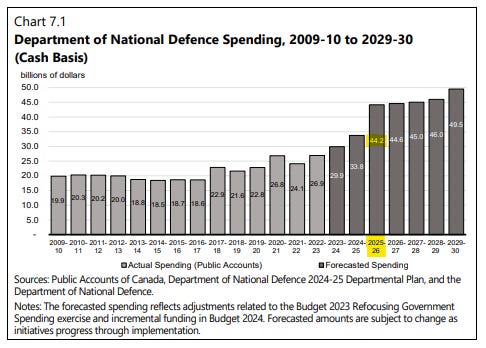
This chart is from page 303 of Canada’s 2024 Federal Budget. On it, we can see a planned increase in the Department of National Defence’s budget of just over $10 billion between 2024 and 2025.
Before relying too much on this figure, it’s important to verify it shows what it appears to show. The $10 billion increase between 2024 and 2025 is obvious. However, the $44.2 billion figure here, added to Carney’s new $9.2 billion does not add up to the ~$60 billion needed to hit the 2 percent of GDP threshold.
The key to understanding that gap is to realize that the $44.2 billion from this chart, plus the $9.2 billion Carney announced are both (almost) entirely DND spending. However, NATO’s definition of defence spending is broader than that, and includes spending from other departments when it contributes to defence. There is no public figure for what this non-DND defence-related spending is expected to be in 2025, however, the Library of Parliament’s paper on “Making Sense of Canada’s Defence Spending” indicates that the 2023 figure was $7.3 billion. If we assume that hasn’t changed, and add it to our DND figures, it entirely closes the gap to ~$60b.
Regardless, what matters most here is that in addition to Carney’s $9.2 billion, there was already an pre-programmed increase of approximately $10 billion in defence-related spending for 2025. There is no “gap” which requires re-profiling of existing expenses to explain how it will be filled.
This doesn’t mean, however, that the increased spending planned under Trudeau deserves the benefit of the doubt. It’s important to confirm that this is also spending that’s actually contributing to Canada’s defence.
Doing this is slightly more complicated with a budget. It addresses a longer time horizon than Carney’s more immediate announcement.
Some examples of specific defence spending listed include:
Around $38 billion over 20 years in the largest upgrade to NORAD
$11.5 billion over 20 years for Canada’s contribution to increasing NATO’s common budget and to establish a new regional office in Halifax for NATO’s Defence Innovation Accelerator for the North Atlantic; and,
$10.4 billion for up to 16 new P-8A Poseidon aircraft
These are intended to be representative, not comprehensive. The budget contains a couple dozen spending items of this sort, with no clarity about what portion of each item’s budget will be spent in the 2025 fiscal year. There are other public documents which may provide more insight, but what’s important here is that this is the pool of projects contributing to the significant increase in programmed spending in 2025, and that, going by their descriptions, they appear to be substantively defence-related projects.
However, project descriptions alone are not perfect proof of legitimacy. There’s no guarantee that top-line descriptions accurately represent what’s happening within the programs, while secrecy and technical details can make it difficult for outside, public-information dependent, analysis to look deeper.
What’s needed is an assessment from someone outside the Canadian government, with expertise and access to detailed project information, who can look at these individual projects, determine if they meet NATO’s defence spending definitions, and share their final conclusions publicly.
Fortunately, we have exactly that.
Earlier in this discussion, one of the reasonable rationales presented as a justification for skepticism about whether Canada’s increases in defence spending are substantive, or just a paper exercise, was that Canada has previously submitted spending claims to NATO which were deemed ineligible under the alliance’s common definitions of defence spending.
However, this history also demonstrates that NATO does not simply accept member states’ claims at face value. Instead, countries submit detailed data which is reviewed, scrutinized, and vetted before being included in official reports. This allows us to treat information in such reports as having been confirmed as legitimate spending by informed, impartial, experts.
NATO’s most recent Defence Expenditure of NATO Countries report was released in August, and includes estimates for the 2025 fiscal year. In that report, Canada’s estimated defence spending for 2025 is $62.713 billion - equivalent to 2.01% of GDP.


There are, of course, caveats. GDP figures are based on OECD projections and could change. The spending targets are based on government plans, not signed contracts and prices can fluctuate. Either of these factors could sway the final percent-of-GDP figure somewhat. Also, Canada actually needs to spend the money it’s told NATO it plans to spend - which relates back to earlier questions about Canada’s capacity to spend so much extra money in a single year. But that’s still a topic for another time.
This brings us to the final reason why skepticism that the government intends to spend this money on defence doesn’t make sense. Mark Carney did not have to promise to hit the 2 percent benchmark in 2025.
Canada’s existing commitment was that it would spend 2 percent of its GDP on defence by 2032. If Carney’s goal had been international praise, or domestic approval, he could have accelerated the timeline to 2028 or 2029.
Choosing 2025, instead, creates political risk. It shortens the runway, increases scrutiny, and gives opponents a clear criticism it can use in the next election if the government falls short of its target at all.
The only motivation that really makes sense for setting such a near-term target is that the Prime Minister wants the effects of that increased spending - in terms of Canada’s real defensive capability and capacity - to arrive sooner. And if that’s the motivation for setting the target this year, it doesn’t make sense to play a shell game which makes it appear that the money is being spent, but doesn’t deliver the actual capability.
None of these arguments are ones which lend themselves to absolute conclusions. Defence spending is large, and complex, with a lot of gray area. Any claim that there’s zero re-profiling of existing spending, or zero cases where a non-defence project has been included under defence spending, can probably be proven inaccurate by a counter example.
However, the absence of any obvious flags in the descriptions of spending projects in the relevant spending announcements or the budget, coupled with NATO vetting, and the absence of any upside in taking the political risk this promise creates without the intention to follow through, combine to create a compelling case:
The Canadian government appears to genuinely intend to meet NATO’s benchmark of spending two-percent of GDP on defence in 2025 - and to do it in a way that shows up not just on paper, but in steel.
Thank you for reading this piece! I’m genuinely grateful that you took the time.
This piece is a bit of a departure for me from what I usually write, and I’ve love to hear what you think in the comments.
Second, if you’d like to support my work without the commitment of a paid subscription, you can send me a one-time tip via Stripe, and buy me a coffee (or a little bit more).
Please don’t feel any pressure, all my work will continue to be available for free. However, earning a few dollars does make it easier for me to write pieces more often.
Thanks!
Man I appreciate your work, very thorough and in depth; keep it!
The Parliamentary Budget Officer confirms the June 2025 announcement adds over $9 billion in new defence authorities, pushing planned spending past $62 billion for 2025-26. Yet this total hinges on details Parliament lacks, such as whether funds accelerate existing projects or launch fresh ones. NATO's vetting will test eligibility, but actual expenditures, not forecasts, seal the pledge's strength. Canada edges closer to 2%, though execution remains the true measure.