


If you follow anyone who discusses Canadian defence procurement - journalists, analysts, terminally-online aviation guys - you’ve probably read something related to the F-35 v. Gripen debate.
Hell, you’re probably exhausted by the F-35 v. Gripen debate.
I recently wrote a piece exploring why Canada may be more constrained than some Gripen fans would like in its ability to add Gripens to the F-35s we’ve already committed to. The core of the argument was that Canada has so few fighter pilots and technicians - and especially few of those experienced enough to form an initial cadre of trainers and leaders needed for a successful transition to a new type - that to remove two such groups out of existing CF-18 squadrons could easily cripple the CF-18s’ ability to operate effectively during the years before a new fleet takes over.
That same argument applies to Rafales, Eurofighters, Super Hornets, Strike Eagles, Fighting Falcons, and Boramaes - essentially, the entire list of Western fighters that could plausibly serve as front-line options for Canada.
That argument was, if not entirely novel, at least a rationale that hadn’t been the headline case in the three thousand articles on this topic published before it. And even then, when I released it over a week ago, it already felt like it barely snuck in under the exhaustion curve - a curve that has since been dragged even lower by another 3,000 articles.
That all begs the question, why am I writing about this topic again?
Because I think the reason people are exhausted isn’t the volume of commentary. It’s that both the Gripen and F-35 are problematic, so all the options kind of suck.
The F-35 is a prima donna of an aircraft - obscenely expensive to operate, hard to keep flying even when you’re willing to spend the money, and a platform that deepens Canada’s reliance on an increasingly unreliable United States. The concern with being reliant isn’t mythical “kill switches” so much as the risk that the flow of spare parts could be leveraged in trade disputes or interrupted during crises - when the U.S. instinctively hoards supply, forgetting that Canadian security is American security (as we saw with PPE early in COVID). Even compared with other U.S. aircraft, or aircraft with significant U.S. components (including Gripen), the F-35 has a particularly short sustainment horizon in the face of American malignance, or just inattention.
Those who’ve followed my work may assume I view the Gripen more favourably. After all, I wrote a piece in the spring arguing it could serve Canada’s sole fighter and even highlighted how it had some operational advantages despite its lower capability. However, that argument was framed against the unspoken threat of President Trump blocking an F-35 acquisition - something that hasn’t materialized.
The fact is, Gripen is a red headed stepchild of an aircraft, sold by a country which doesn’t control the entire ecosystem of equipment - engines, munitions, sensors - needed to make the aircraft truly independent. It also barely meets Canada’s minimum requirements to serve as our sole combat aircraft, while mixed-fleet options that pair it with the F-35 either (at best) save less money than one would hope considering the lower capability ceiling, and may end up being more expensive than just operating an equivalent number of F-35s.
Who wouldn’t become exhausted trying to balance options as terrible as those?
Fortunately, there may be another option that lets Canada conduct its most important air-combat missions without relying solely on the F-35, generates significant cost savings, and doesn’t add pressure to Canada’s limited pool of pilots and technicians.
How is this possible, when I already said that every Western front-line fighter would present similar issues for Canada as the Gripen?
For those who aren’t familiar with it, allow me to introduce you to the KAI Golden Eagle.
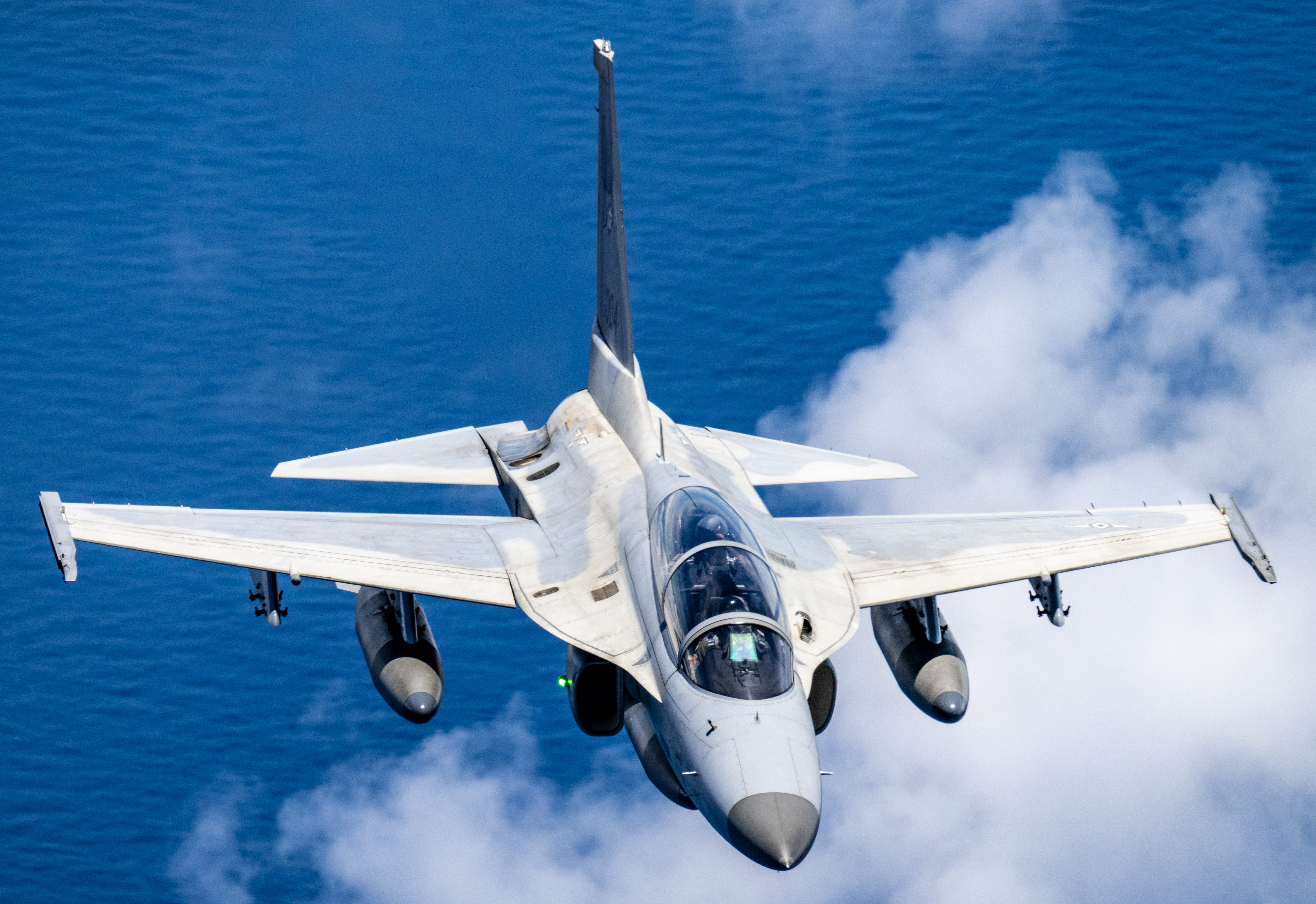
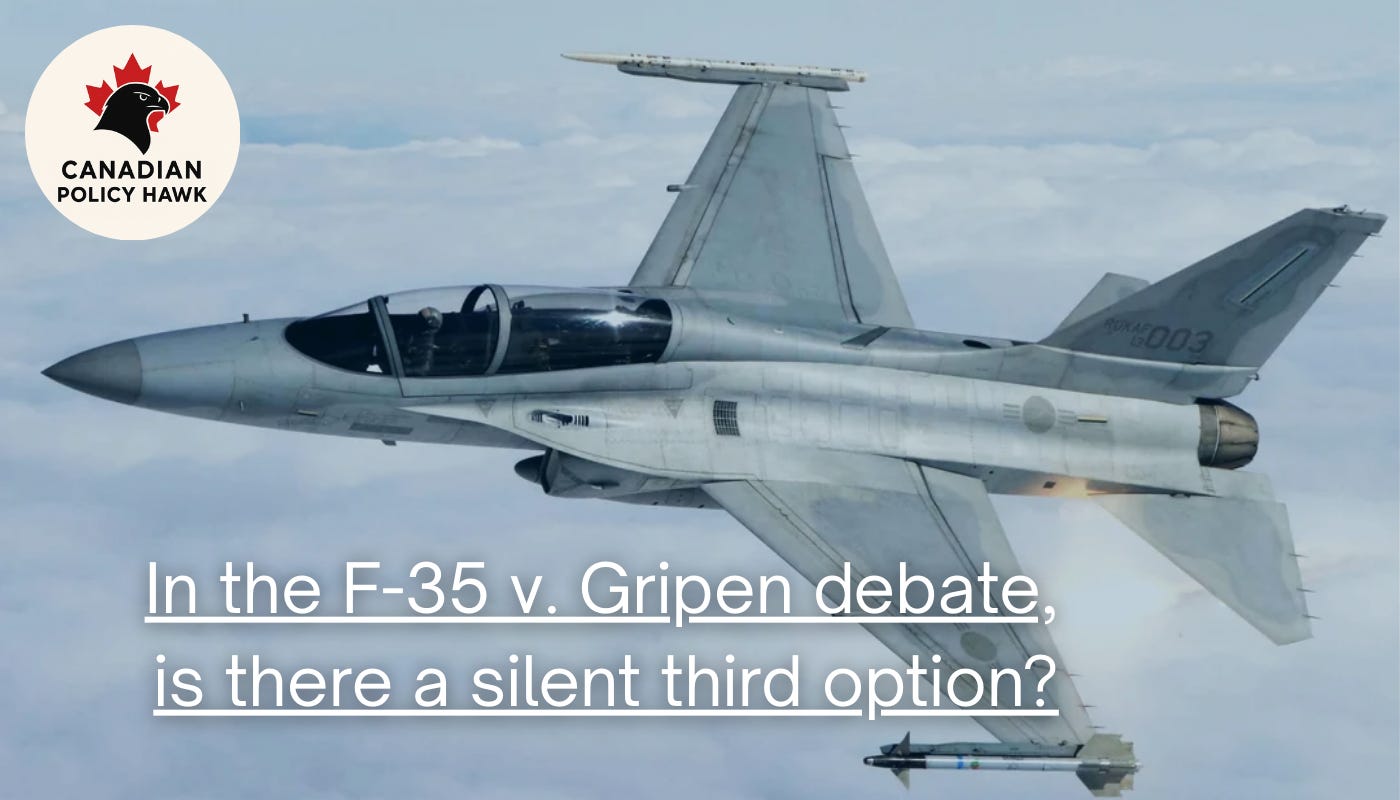
This is a 21st century, supersonic jet trainer developed for and by the Republic of Korea, which can also be equipped with modern combat systems.
The reason this aircraft provides a substantively different option from the Gripen is that, having retired the CT-155 Hawk in 2024, Canada is currently shopping for a new advanced trainer for its lead-in fighter program - and the Golden Eagle is on the shortlist.
This means acquiring it wouldn’t force the RCAF to operate yet another aircraft type. The Golden Eagle could serve both as a lead-in fighter trainer and as a combat-capable complement to a front-line fighter like the F-35. If it also replaced the Snowbirds’ venerable CT-114 Tutor - something it would be well-suited for - the RCAF would actually be operating fewer distinct aircraft types than it did in 2024.
In concept, other trainers could be used in a dual (or triple) role - manufacturers of every training aircraft ever designed have touted the potential for a light combat variant. However, the Golden Eagle is among the most successful in this regard in the modern era - having actually sold more combat-capable variants (the TA-50 or FA-50) than pure trainers.
Let’s be clear that the idea is not for the Golden Eagle to become Canada’s primary combat aircraft. If we had access to the full list of requirements used to compare Gripen and the F-35 in 2022, we’d almost certainly find tasks the Golden Eagle can’t perform—especially in overseas deployments. We need something more capable for our most technically demanding mission,s and since we’ve already paid for our first F-35s, it’s unlikely to be anything else.
But our most important fighter mission, the defence of Canada, isn’t our most technically demanding. In my earlier piece on Gripen’s capabilities, I noted that the defence of Canada is a mission even a 1982-vintage CF-18 (minus forty years of wear) could still handle adequately. This meant that whether the goal is to provide extra mass for Canadian security, free up F-35s for deployments abroad, or provide a backstop if U.S. actions ground the F-35 fleet - the Golden Eagle is very capable of contributing.
Start with range. Canada is big, and an aircraft needs to reach remote places to effectively defend it. Technical data on the Golden Eagle - especially the combat variants - can be sparse, but if you take the base model’s advertised range and fuel load, then factor in the additional fuel capacity provided by the combat variant’s conformal tanks, you get a range using internal fuel roughly on par with (or slightly better than) the CF-18’s. That would change with a heavy load, but, for the air-to-air loadouts used for domestic defence, that’s no issue. Both aircraft also support aerial refuelling and drop tanks. So, as a rule of thumb, an FA-50 can reach anywhere in Canada a CF-18 can - which makes it useful for many tasks.
When it comes to weapons, the Golden Eagle’s options are varied - if not always especially deep. It’s capable of deploying a number of American, European, and indigenous Korean manufactured weapons in both the air-to-air and ground-attack roles. The American weapons include items Canada has stockpiles of for use on the CF-18 and apparently intends to continue to use on the F-35, meaning no new stockpiles are required. Meanwhile, the variety of sources for weapons Golden Eagle can use provides resilience in options for supply. It’s true that integration of some European weapons we may want, like the Meteor, have been discussed but not completed. But they seem to be practical, and Canada could take the lead on those if we felt it was important.
Electronic systems are more mixed. The Golden Eagle carries a modern AESA radar with a contemporary interface - a great addition for the training role the aircraft will fill for pilots heading to the F-35 fleet - but with power output somewhere between the CF-18’s original radar and the early-2000s upgrade it uses today. This is an area where the Golden Eagle is a step down from today’s modernized CF-18s, but still above the “1982 CF-18” threshold that I’ve suggested is adequate for a secondary combat aircraft. The Golden Eagle also includes Link 16, NATO’s standard tactical data link, which again has training benefits as well as operational ones. NORAD has different data-sharing requirements from the more standardized ones that are used throughout NATO and would require U.S. approval for full integration. I’m curious if the US might be more open to integrating NORAD systems into the Golden Eagle than they are with the Gripen, since the Golden Eagle has the mixed-blessing of being partly a Lockheed Martin product. But this isn’t something we can determine from open source materials, so we have to accept that it’s possible that Canada would have to decide if Link 16 alone is “good enough” for a second-string combatant.
Lockheed Martin’s involvement in the Golden Eagle also opens up another consideration. While those whose main motivation for acquiring a second fighter is a separation from the US to the maximum degree possible will see this as a drawback, it’s possible that a choice by Canada to modestly reduce F-35 numbers in favour of Golden Eagles might not be viewed as an unfriendly act by Washington - especially if Lockheed signals tacit acceptance.
Engines are another case where the Golden Eagle keeps us somewhat dependent on the US, but not nearly as tightly as a fully F-35 fleet would, or even a mixed F-35/Gripen fleet might. All three of these aircraft use American engines, which have some component manufacturing or assembly happening outside the United States, but still all require some components only made in America. However, the amount of American input needed for the F-35’s PW F135 engine is more than is needed for the Gripen E’s GE F414 engine, which is more than the Golden Eagle’s GE F404 engine. Each represents a decreasing value on a scale of dependence on the US. The Golden Eagle’s F404 is actually the same engine the CF-18 uses, so the RCAF has significant experience and expertise maintaining it already, and Canada hosts a “Centre of Excellence” for the F404, with deep experience in overhaul and repair. This means that, short of the US using ITAR to block the initial sale - something unlikely with the Gripen, but even less likely with Golden Eagle - its leverage to make it difficult for Canada to continue to operate the Golden Eagle is limited.
One major unknown - an area of strength for the Gripen - is economic benefits in the form of industrial participation - including Canadian manufacture or assembly. Korea has a track record of generous technology transfer and local manufacturing, but these are negotiated case-by-case. There’s been virtually no public discussion of what Canada might receive, so this has to be an area where we can hope the Golden Eagle would perform well, but we can’t know specifics.
One possibility, if significant manufacturing or assembly of the airframe isn’t possible, is to pursue manufacturing of the GE F404 engine. Canada’s existing industrial base supporting it gives us a strong starting point to leverage into manufacture. And, despite its age, it’s an engine that’s still in demand and will be for a long time to come. This may produce just as many economic benefits as producing airframes without engines would, as modern fighters can be seen as half engine, half airframe, when it comes to manufacturing complexity and cost. Again, though, whether this is a possibility is impossible to assess.
The other economic consideration, cost, however, is clearer. Recent international Golden Eagle contracts land in the US$50–60 million per aircraft range with full combat packages. Flyaway costs are murky, but this compares favourably with Gripen, which claims a US$85–100 million flyaway and has full-package contracts exceeding US$200 million per aircraft. Those aren’t apples-to-apples, but the pattern is consistent: the Golden Eagle is significantly cheaper to acquire.
Operational costs are harder to pin down, but a smaller airframe with a single F404 will almost certainly cost less per hour than modern Gripens - often touted as the cheapest Western front-line fighter.
While we’re comparing: one criticism of Gripen is that by the time Canada buys it and reaches full operating capability, it may be relatively few years before it’s truly obsolete and can’t be used in some of the roles we view as mandatory. Meanwhile, the Golden Eagle sidesteps this. Since it’s not required to fulfill the most technically difficult missions, it may actually be longer before it needs to be replaced due to obsolescence. And if it does hit the end of its combat utility partway through its service life, the airframes can simply transition into the training fleet, remaining useful for decades - where the Gripens might have to be retired.
None of this is to suggest that the Golden Eagle is the perfect solution for Canada. Acquiring it would be, at its core, a compromise. However, it navigates around some potential deal-breakers that other options cannot, and it delivers capabilities that address many of the concerns driving Canada’s ongoing review of its F-35 purchase.
I hope, considering all of this, that the Golden Eagle can be an option that doesn’t suck so much it’s exhausting to talk about. But, at the very least, I think it’s worthy of discussion and should no longer be the silent third option.
Thank you for reading this piece! I’m genuinely grateful that you took the time.
The thoughts within this piece are largely built upon the arguments of Maple Chaos over on X, whose been pushing for the trainer/combatant possibility for a long time - even when I was convinced it couldn’t work.
If you’d like to support my work without the commitment of a paid subscription, you can send me a one-time tip via Stripe, and buy me a coffee (or a little bit more).
Please don’t feel any pressure, all my work will continue to be available for free. However, earning a few dollars does make it easier for me to write pieces more often.
Thanks!
Thank you for this. It’s the most helpful and constructive piece I’ve read on this debate to-date. There is a lot to like about it. As you say, the personnel issue is the critical point few are talking about — other than to oppose a dual fleet — and it’s Forces wide, not just RCAF. So reducing platform count, replacing two obsolete aircraft (Hawk & Tutor) while leveraging the existing F404 experience and supply chain personnel sounds like a win-win-win instead of the typical short sighted and costly compromise we (Canada) often land on. It’s not completely independent, but nothing is (sorry, Arrow 2 dreamers). And Snowbird pilots get to fly something younger than their fathers. :)
I also think this would be more politically palatable. Harder for the F-35 only jocks to argue against. It leaves capacity & space to develop drone capabilities (the future). And starts building a defence relationship with Korea, especially if we choose European subs.
Huh, that’s definitely not an option I had been expecting; I frankly don’t hate it lol.
I’m definitely hard in the pro-duel fighter fleet camp, mostly for the long term industrial benefits if I’m being honest with myself; but I hadn’t considered this possibility. I like that it can also fill the role of a trainer and stunt plane, it’s a nice perk.
A refreshing break from the usual drudgery. I wish the government would just make a damn decision so I can stop dreaming about it and put it to rest haha.